
What's Happening?
President Trump has promoted a U.S. Census Bureau analysis claiming that 24,000 noncitizens illegally voted in the 2020 election. This finding, touted by President Trump on social media, is presented as evidence
supporting his long-standing claims about the 2020 election outcome. The Census Bureau report, which examined over 128 million voters, concluded with 'high confidence' that 24,000 noncitizens cast ballots, representing less than 0.019% of the sample. President Trump indicated that further analysis of an additional 32 million voters is expected to significantly increase this number. However, experts are raising substantial questions regarding the methodology and validity of the study. Critics point out that the report lacks details on its authors and the reliability of the data used, which is atypical for Census Bureau publications. Previous claims by President Trump about noncitizen voters in specific states have also been challenged by state officials who reported no understanding of the administration's methodology.
Why It's Important?
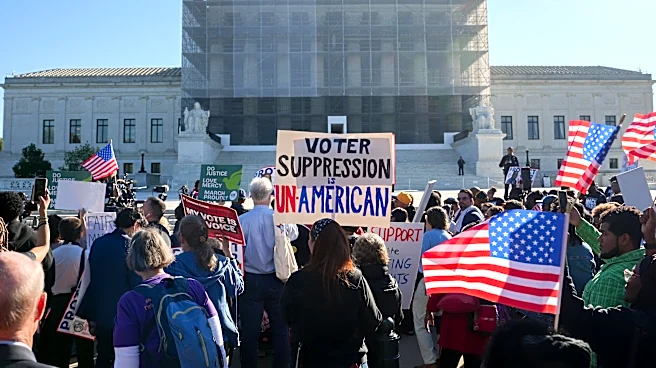
This report is significant as it fuels President Trump's legislative priority to require proof of citizenship for voter registration and to limit mail-in voting, measures that critics argue could disenfranchise eligible voters. The findings, despite their small percentage relative to the total votes, are being used to advocate for stricter election laws, potentially impacting voter access and the integrity of future elections. The controversy surrounding the report's methodology also raises concerns about the politicization of federal agencies and the potential erosion of public trust in official government data. If the report's findings are widely accepted without critical examination, it could lead to policy changes that disproportionately affect certain demographics and alter the landscape of U.S. electoral processes. The ongoing debate highlights the tension between ensuring election security and protecting voting rights.
What's Next?
The report's findings are likely to continue to be a central point in discussions surrounding election reform and voter ID laws. President Trump has already lobbied for federal legislation requiring proof of citizenship for voter registration, an effort that has stalled in the U.S. Senate. Federal courts have previously blocked major provisions of President Trump's executive orders related to elections, suggesting that any new legislative or executive actions based on this report could face similar legal challenges. Opponents of stricter voting laws are expected to continue scrutinizing the report's methodology and advocating for policies that protect broad voter access. The debate will likely intensify as the next election cycle approaches, with both sides using such reports to bolster their arguments for or against changes to election administration.
Beyond the Headlines
The controversy extends beyond the immediate claims of noncitizen voting, touching upon deeper issues of data integrity, scientific rigor in government reports, and the weaponization of statistics for political ends. The lack of transparency regarding the report's authors and methodology, as noted by former Census Bureau staff, suggests a potential departure from established scientific practices within a federal agency known for its reputable analysis. This could set a precedent for future government reports, where political objectives might overshadow scientific objectivity. Furthermore, the report contributes to a broader narrative that questions the legitimacy of U.S. elections, potentially undermining democratic institutions and public confidence in electoral outcomes. The ongoing legal battles and expert criticisms underscore the ethical implications of using unverified or questionable data to influence public policy and political discourse.