
What's Happening?
Astronomers have identified two enormous structures in deep space, known as the Giant Arc and the Big Ring, which appear in the same region at the same cosmic distance. These findings, reported by Alexia
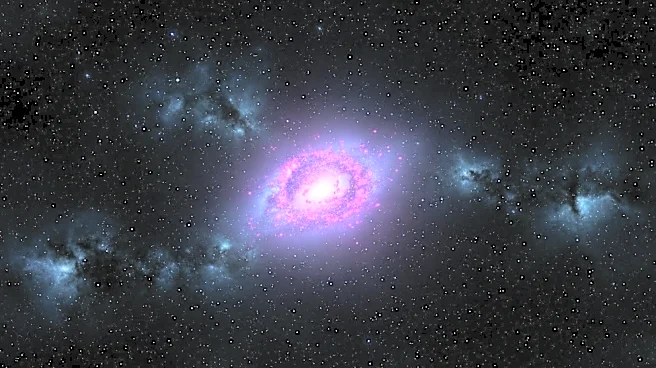
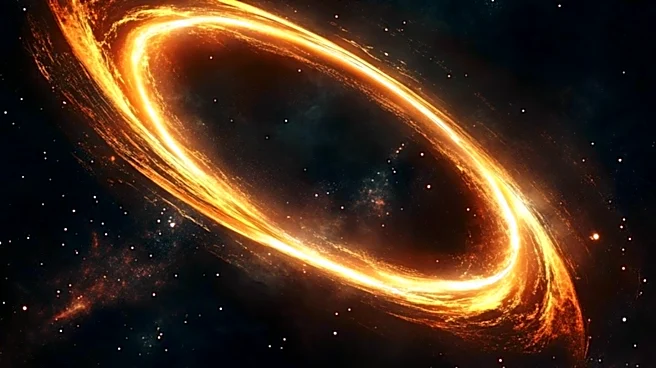
M. Lopez and her team, challenge the current understanding of cosmology. The Giant Arc stretches about 3.3 billion light-years, while the Big Ring spans approximately 1.3 billion light-years. Both structures are located about 9.2 billion light-years from Earth, suggesting they formed when the universe was roughly half its current age. The proximity and size of these structures raise questions about the assumption that the universe should be increasingly uniform on large scales.
Why It's Important?
The discovery of the Giant Arc and Big Ring is significant because it challenges the standard model of cosmology, known as Lambda-CDM, which posits that the universe should be homogeneous on large scales. If these structures are confirmed as physical systems, it could imply that the universe is more 'lumpy' than previously thought, potentially requiring a reevaluation of cosmological principles. This could impact our understanding of the universe's formation and evolution, influencing future research and theoretical models in cosmology.
What's Next?
Future surveys and analyses are expected to test the validity of these structures. Larger quasar catalogues and deeper galaxy maps will help determine whether the Giant Arc and Big Ring persist as real structures or if they are statistical anomalies. Simulations will also be conducted to assess how often such patterns should appear under the current cosmological model. These efforts will be crucial in determining whether the current understanding of the universe needs to be revised.
Beyond the Headlines
The potential implications of these findings extend beyond immediate cosmological models. If confirmed, the existence of such large structures could suggest new physics or unknown processes in the early universe. This might lead to the exploration of alternative theories, such as cosmic strings or other speculative ideas, to explain these anomalies. The findings also highlight the importance of statistical methods in cosmology and the need for rigorous testing of observed data against theoretical predictions.