






What's Happening?
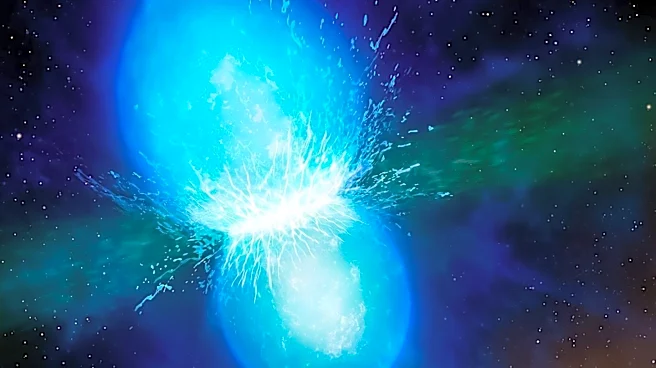
A research team from Technische Universität Darmstadt has made significant progress in understanding the origin of heavy elements like gold, platinum, and uranium. Their study, published in Physical Review Letters, focuses on the rapid neutron-capture
process, or r-process, which occurs during neutron star collisions. The team used a modern ab initio approach to calculate nuclear masses, providing a more accurate prediction of how these elements form. Their findings suggest that the formation of heavy elements occurs more slowly than previously thought, with matter accumulating longer in certain regions before heavier elements can form.
Why It's Important?
This research has profound implications for our understanding of the universe's chemical composition. By providing a more accurate model of how heavy elements are formed, it challenges existing theories and could lead to a reevaluation of the processes involved in stellar nucleosynthesis. This could impact fields ranging from astrophysics to nuclear physics, as well as our understanding of the cosmic origins of elements that are crucial for various technologies and industries.
What's Next?
The study highlights the need for further experimental and theoretical work to explore the r-process and the formation of heavy elements. Future experiments at advanced research facilities could provide more data to refine these models. Additionally, the study's findings could guide the development of new technologies and materials that rely on these elements, potentially influencing sectors such as electronics, medicine, and energy.
Beyond the Headlines
The research underscores the importance of combining experimental data with theoretical models to advance scientific understanding. It also highlights the challenges of studying phenomena that cannot be directly observed in laboratories, emphasizing the role of innovative computational methods in modern science.