What's Happening?
An international team of researchers, including those from the University of Geneva and the National Centre of Competence in Research PlanetS, has observed a massive helium cloud escaping from the exoplanet
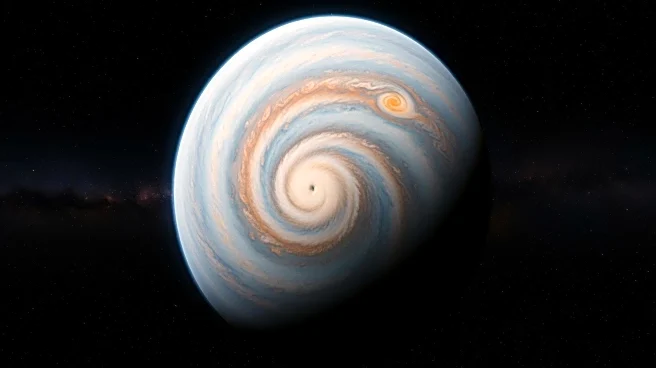
WASP-107b using the James Webb Space Telescope. This marks the first time the telescope has detected helium on an exoplanet, providing new insights into atmospheric escape—a process where planets lose atmospheric gases to space. WASP-107b, located over 210 light-years away, is categorized as a 'super-puff' planet due to its large size and low density, similar in size to Jupiter but with only a tenth of its mass. The helium cloud, originating from the planet's exosphere, is so extensive that it dims the star's light before the planet transits in front of it. The study also identified other atmospheric components such as water, carbon monoxide, and ammonia, but no methane, suggesting a complex atmospheric history.
Why It's Important?
The detection of helium and other gases escaping from WASP-107b provides critical data for understanding atmospheric escape, a phenomenon that significantly influences planetary evolution. This process is particularly relevant for planets orbiting close to their stars, where intense heat can cause substantial atmospheric loss. The findings from WASP-107b offer a reference point for studying how exoplanets change over time, potentially affecting their habitability. Understanding atmospheric escape is crucial for interpreting the characteristics of exoplanets and could explain the absence of water on planets like Venus. The research underscores the importance of the James Webb Space Telescope in advancing our knowledge of distant worlds and their atmospheric dynamics.
What's Next?
Future research will likely focus on further observations of WASP-107b and similar exoplanets to refine models of atmospheric escape and migration. The James Webb Space Telescope will continue to play a pivotal role in these studies, offering detailed insights into the composition and behavior of exoplanetary atmospheres. Scientists aim to explore the implications of atmospheric escape on the potential habitability of rocky exoplanets and the evolution of their atmospheres over time. These studies could also inform our understanding of atmospheric processes on Earth and other planets within our solar system.
Beyond the Headlines
The study of atmospheric escape on exoplanets like WASP-107b has broader implications for understanding the potential for life beyond Earth. By examining how atmospheres evolve and are lost, scientists can better assess the conditions necessary for sustaining life. The research also highlights the dynamic nature of planetary systems and the complex interactions between planets and their host stars. As technology advances, the ability to detect and analyze atmospheric components on distant worlds will enhance our understanding of the universe and our place within it.