
What's Happening?
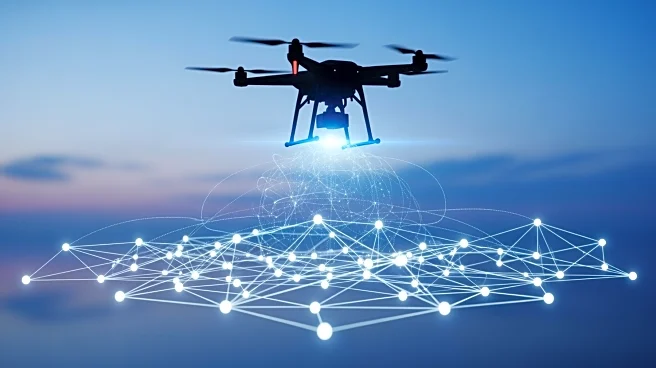
Researchers at Virginia Tech have developed a novel framework using quantum entanglement to improve communication between drones in disaster relief scenarios. The framework, known as eQMARL (entangled
quantum multi-agent reinforcement learning), leverages the unique properties of quantum bits, or qubits, to enable secure, network-independent communication. This approach offers advantages over classical computing and non-entangled quantum systems, particularly in environments where traditional wireless signals may be disrupted.
Why It's Important?
The use of quantum entanglement in drone communication could revolutionize disaster relief efforts by providing a more reliable and secure method of data transfer. This technology has the potential to enhance coordination and efficiency in emergency response scenarios, where communication networks are often compromised. Additionally, the broader implications for secure data sharing and AI applications highlight the transformative potential of quantum technologies in various fields.
What's Next?
While the deployment of this technology in disaster response scenarios may still be years away, ongoing advancements in quantum computing and real-world testing are bringing these applications closer to reality. Researchers will continue to explore the potential of quantum entanglement in communication systems, with the aim of integrating these technologies into practical use cases.
Beyond the Headlines
The development of quantum communication systems raises important questions about cybersecurity and data privacy. As these technologies become more prevalent, there will be a need to address the ethical and legal implications of their use. Additionally, the integration of quantum and classical technologies may lead to new standards and frameworks for communication systems.