






What's Happening?
China's New Energy Vehicle (NEV) market, which includes Battery Electric Vehicles (BEV) and Plug-in Hybrid Electric Vehicles (PHEV), has reached a significant milestone with a 63% market share in May, according to the China Passenger Car Association (CPCA).
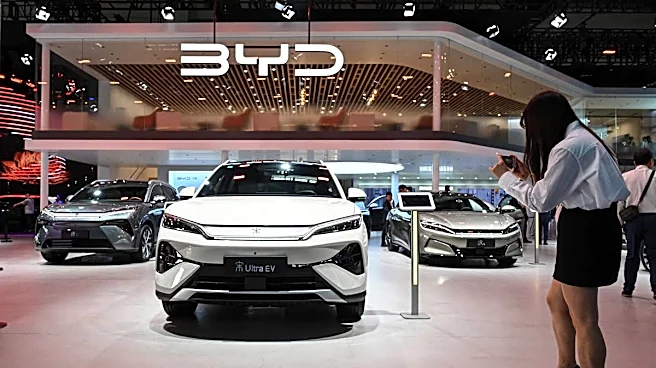
This growth is marked by a 15% month-over-month increase in retail sales, despite a 5% year-over-year decline. The wholesale NEV sales, including exports, rose to 1.36 million units, up 12% year-over-year. BYD, a major player in the Chinese NEV market, contributed significantly to these figures, although its retail sales within China saw a decline. The company is undergoing a major product transition, introducing new models with advanced technology like the Blade Battery 2.0, which promises faster charging times and lower costs compared to traditional internal combustion engine vehicles.
Why It's Important?
The rapid expansion of China's NEV market highlights a potential shift in global automotive trends, with China leading the way in electric vehicle adoption. This growth is supported by substantial infrastructure development, including plans to bring 28 million charging facilities online by 2027. The increasing prevalence of fast-charging stations further enhances the appeal of EVs over traditional gasoline vehicles, which are becoming less attractive due to rising costs and supply uncertainties. China's advancements in NEV technology and infrastructure could influence global markets, encouraging other countries to accelerate their transition to electric vehicles. This shift could have significant implications for the global automotive industry, energy policies, and environmental strategies.
What's Next?
As China continues to expand its NEV infrastructure and introduce new models, the market share of electric vehicles is expected to grow further. The Chinese government has tools at its disposal to stimulate this growth, such as policy adjustments and incentives. The potential for reaching a 70% market share in the near future is plausible, especially if supply constraints are addressed. The global impact of China's NEV market expansion could lead to increased competition and innovation in the automotive industry, with other countries potentially adopting similar strategies to boost their own EV markets.