
What's Happening?
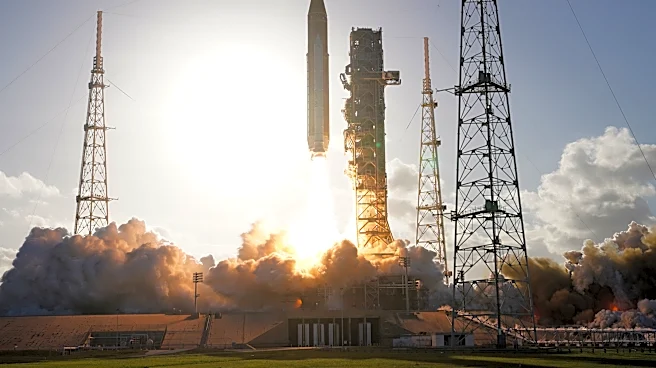
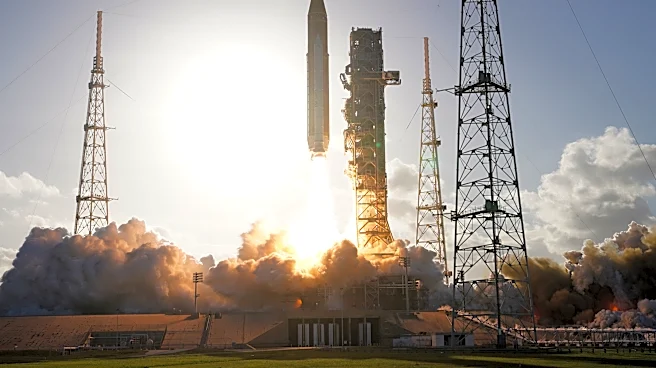
NASA's Artemis II mission has successfully departed Earth orbit, marking a significant milestone as it embarks on a lunar flyby. The mission, which includes NASA astronauts Reid Wiseman, Victor Glover,
Christina Koch, and Canadian Space Agency astronaut Jeremy Hansen, is the first crewed mission to leave Earth orbit since Apollo 17 in 1972. The Orion spacecraft, launched by NASA's Space Launch System rocket from Kennedy Space Center, is on a 10-day test flight around the Moon. After reaching space, Orion deployed its solar array wings and transitioned into flight operations. A key translunar injection burn propelled the spacecraft out of Earth orbit towards the Moon. The mission aims to conduct a lunar flyby on April 6, where astronauts will capture high-resolution images and observations of the Moon's surface, including its far side.
Why It's Important?
The Artemis II mission is a pivotal step in NASA's broader Artemis program, which aims to return humans to the Moon and eventually establish a sustainable presence there. This mission not only tests the capabilities of the Orion spacecraft with a crew onboard but also gathers critical data that will inform future missions. The success of Artemis II is crucial for the planned Artemis III mission, which intends to land astronauts on the lunar surface. The mission's progress is a testament to international collaboration in space exploration, as it includes a Canadian astronaut, highlighting the global interest and cooperation in lunar exploration. The data and experience gained from this mission will be instrumental in advancing human space exploration and could have significant implications for future missions to Mars and beyond.
What's Next?
Following the lunar flyby, the Orion spacecraft is scheduled to return to Earth, with a planned splashdown in the Pacific Ocean off the coast of San Diego. The mission's completion will be closely analyzed to assess the performance of the spacecraft and its systems. The insights gained will be used to refine and improve future Artemis missions. NASA will continue to prepare for Artemis III, which aims to land astronauts on the Moon, potentially as early as 2025. The success of Artemis II will also influence international partnerships and collaborations in space exploration, as countries and private entities look to participate in the next era of lunar exploration.