



What's Happening?
An international team of researchers has identified an accelerating degradation of permafrost across the Arctic, Antarctic, and high-mountain regions. This conclusion is based on over two decades of field observations from 156 monitoring sites globally.
The study, published in Nature Communications Earth & Environment, indicates that the active layer—the ground's uppermost section that thaws in summer and refreezes in winter—is deepening at an increased rate. Specifically, 55% of Arctic sites, 38% of Antarctic sites, and over 90% of monitored mountain sites are experiencing a deeper thaw. This research represents the first global assessment of long-term active layer monitoring data, involving field teams from more than 20 countries. University of Victoria (UVic) economist Felix Pretis contributed statistical analysis, linking observed thaw to temperature and precipitation, and distinguishing long-term climate-driven changes from local conditions.
Why It's Important?
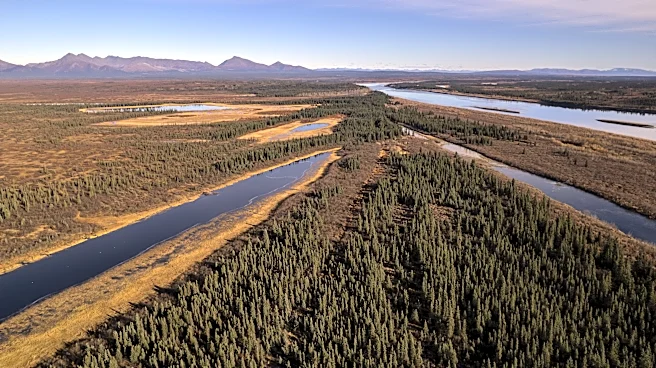
The widespread and accelerating permafrost thaw carries significant implications for global infrastructure and climate. Permafrost, which underlies nearly 15% of the Northern Hemisphere's land surface and almost all ice-free land in Antarctica, is ground bound by ice that remains frozen for at least two consecutive years. A deepening active layer suggests that ice deeper within the ground is also thawing. This process directly threatens critical infrastructure such as roads, pipelines, buildings, and utility systems built on permafrost, leading to potential structural failures and costly repairs. Furthermore, the thawing permafrost releases stored carbon, in the form of carbon dioxide and methane, into the atmosphere. This release contributes to the greenhouse effect, creating a feedback loop that could further accelerate global warming and exacerbate climate change impacts, affecting ecosystems and human populations worldwide.
What's Next?
The continued acceleration of permafrost thaw necessitates urgent attention and adaptation strategies. Governments and international organizations will likely need to invest in comprehensive monitoring systems to track permafrost changes more closely and predict future impacts. Infrastructure development in permafrost regions will require revised engineering standards and innovative construction techniques to withstand unstable ground conditions. Research into methods for mitigating carbon emissions from thawing permafrost, such as carbon capture technologies or ecosystem restoration, may also intensify. Additionally, the findings will likely inform climate policy discussions, emphasizing the need for more aggressive global efforts to reduce greenhouse gas emissions to slow down the rate of warming in polar and high-mountain regions. Indigenous communities in these areas, whose livelihoods and cultural practices are directly impacted, will require support and inclusion in adaptation planning.
Beyond the Headlines
The accelerating permafrost thaw highlights a critical ethical and environmental challenge. Beyond the immediate infrastructural and climatic concerns, the degradation of permafrost represents a profound alteration of ancient landscapes and ecosystems. This phenomenon impacts not only the physical environment but also the cultural heritage and traditional ways of life for Indigenous communities who have inhabited these regions for millennia. The release of long-sequestered carbon and potentially ancient microbes from thawing permafrost could introduce unforeseen ecological and health risks. The study also underscores the interconnectedness of global climate systems, demonstrating how changes in remote polar regions can have far-reaching consequences for the entire planet, urging a re-evaluation of human interaction with natural systems and the long-term sustainability of current global development models.