






What's Happening?
An international team of astronomers, including researchers from Lehman College, CUNY Graduate Center, the IceCube Neutrino Observatory, and the Max Planck Institute, has published new research in Physical Review D proposing that dark matter may originate
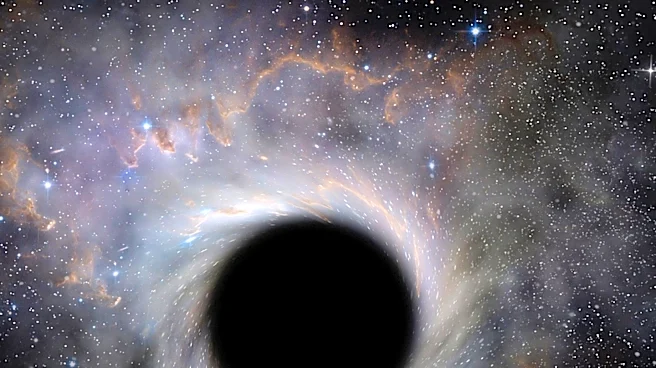
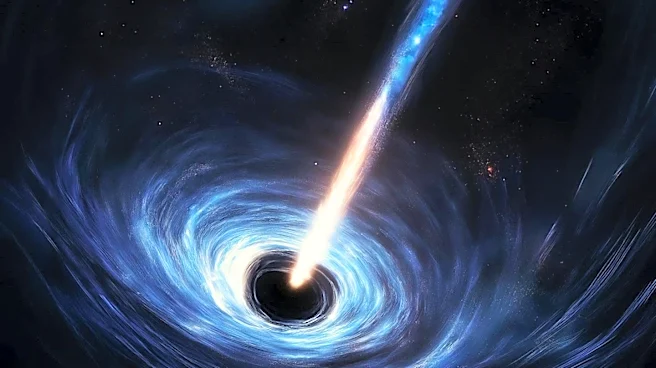
from hypothetical primordial black holes possessing five-dimensional properties. This work builds upon the 'dark dimension scenario' from 2023, which suggested an additional spatial dimension to reconcile dark energy properties with quantum gravity. The new study explores the possibility that this fifth dimension, extending over a microscopic distance, is a genuine feature of our universe. Within this framework, primordial black holes formed in the early universe could have five-dimensional characteristics, altering their behavior compared to conventional four-dimensional black holes. The researchers suggest that some of these five-dimensional primordial black holes, particularly those formed from cosmic strings, could have survived for periods comparable to the age of the universe, making them potential contributors to dark matter.
Why It's Important?
This research offers a novel and unusual explanation for the mysterious nature of dark matter, which constitutes the majority of matter in the universe but remains invisible and undetected directly. By linking dark matter to five-dimensional primordial black holes, the study provides a theoretical framework that could potentially unify several perplexing cosmological observations. The proposed connection between this model and an extraordinarily energetic neutrino detected by the KM3NeT observatory in 2023 adds a potential observational implication, as the neutrino's energy is intriguingly close to a fundamental energy scale predicted by the five-dimensional framework. If confirmed, this theory would fundamentally alter our understanding of the universe's composition and the nature of reality itself, pushing the boundaries of physics beyond the familiar four dimensions of spacetime.
What's Next?
The existence of both primordial black holes and a fifth dimension remains unconfirmed, making this research highly theoretical. Future observations of high-energy neutrinos will be crucial in evaluating these ideas. Scientists will need to gather additional data and place further constraints on the properties of primordial black holes and extra-dimensional physics to test the validity of this model. Continued research in particle physics and cosmology, including experiments designed to detect dark matter or evidence of extra dimensions, will be essential. The potential connection to the energetic neutrino event from KM3NeT will likely prompt further investigation into similar high-energy cosmic ray detections, seeking patterns that might support the five-dimensional primordial black hole hypothesis. The scientific community will be looking for more concrete observational evidence to move this theory from speculation to established scientific understanding.
Beyond the Headlines
The concept of a fifth dimension and its role in fundamental physics has profound implications that extend far beyond explaining dark matter. If our universe indeed possesses an additional spatial dimension, it could reshape our understanding of gravity, quantum mechanics, and the very fabric of spacetime. This research touches upon the intricate relationship between string theory, dark energy, and the early universe, suggesting a more complex and interconnected cosmic reality. The idea that dark matter, a pervasive yet elusive component of the cosmos, could be a manifestation of higher dimensions opens up philosophical questions about the nature of existence and the limits of human perception. It challenges conventional scientific paradigms and encourages a broader, more imaginative approach to solving some of the universe's most enduring mysteries, potentially leading to a paradigm shift in theoretical physics.