



What's Happening?
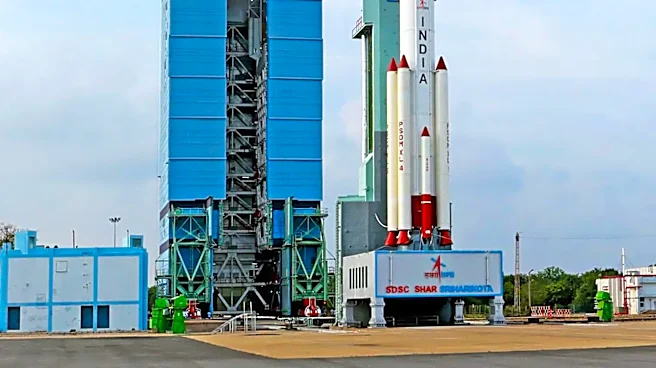
Scientists at the Indian Institute of Astrophysics (IIA), Bengaluru, utilizing India's first space-based solar observatory, Aditya-L1, have uncovered new insights into solar eruption expansion. By combining spectroscopic observations from the Visible
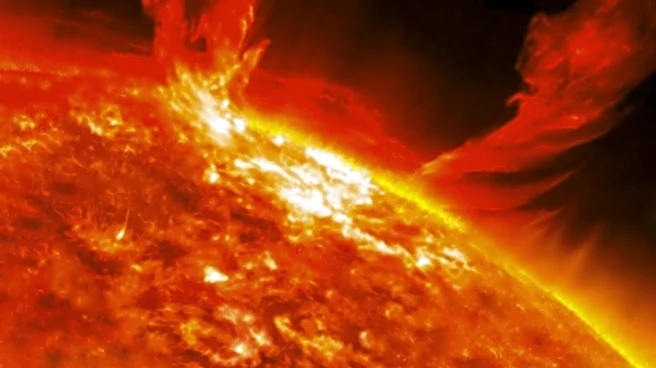
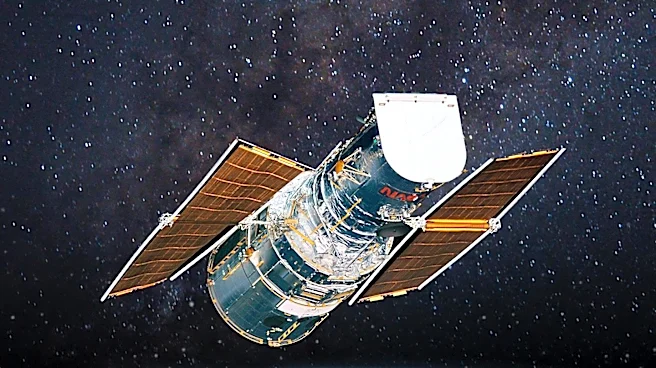
Emission Line Coronagraph (VELC) on Aditya-L1 with images from NASA’s Solar Dynamics Observatory (SDO) and three-dimensional modeling, researchers found that a solar eruption on August 5, 2024, did not expand symmetrically as previously believed. Instead, it underwent non-uniform expansion and developed an asymmetric shape. This discovery, published in The Astrophysical Journal Letters, is crucial for space-weather studies because variations in coronal mass ejection (CME) expansion can influence its speed as it travels towards Earth. The VELC instrument on Aditya-L1 provides unique data by measuring the motion of hot plasma along the line of sight, offering a three-dimensional understanding of these events.
Why It's Important?
Understanding the three-dimensional evolution of solar eruptions, particularly their asymmetric expansion, is vital for improving space weather predictions. CMEs, massive bursts of magnetized plasma from the Sun's outer atmosphere, can cause significant disturbances to satellites and communication systems on Earth. Accurate prediction of their speed and trajectory is a matter of practical importance for protecting critical infrastructure. The traditional assumption of symmetric CME expansion has been challenged by this research, suggesting that current models may need refinement. By providing line-of-sight motion data, Aditya-L1's VELC instrument offers a new window into the early stages of CMEs, where they evolve most rapidly. This enhanced understanding can lead to more reliable predictions of CME arrival times and their potential impacts, benefiting industries reliant on satellite technology and communication networks.
What's Next?
Further studies utilizing Aditya-L1's VELC spectroscopy will aim to establish the reliability of determining the propagation direction, velocity, and expansion of CMEs. This ongoing research will contribute significantly to the understanding and modeling of CME propagation and its effects in space. The insights gained from Aditya-L1 are expected to refine existing space weather models, leading to more accurate forecasts and potentially enabling better mitigation strategies for the impacts of severe space weather events. The collaboration between Indian and U.S. space agencies, as evidenced by the use of NASA's SDO data, highlights the international effort in advancing solar physics and space weather prediction.
Beyond the Headlines
The discovery of asymmetric solar eruption expansion has broader implications for fundamental solar physics. It challenges long-held assumptions about the behavior of these powerful solar phenomena and underscores the complexity of the Sun's dynamic processes. This research also exemplifies the growing capabilities of India in space science and technology, with Aditya-L1 being a testament to its advanced observational instruments. The ability to constrain the three-dimensional geometry of eruptions from a single vantage point, as demonstrated by VELC, represents a significant technological advancement. This could pave the way for more sophisticated space-based observatories capable of providing comprehensive data for understanding and predicting solar activity, ultimately enhancing humanity's resilience against space weather hazards.