



What's Happening?
Scientists believe they may have discovered the explanation for Earth's 'Great Unconformity,' a geological mystery where over a billion years of the planet's history appears to be missing from the rock record. This phenomenon, observed in locations like
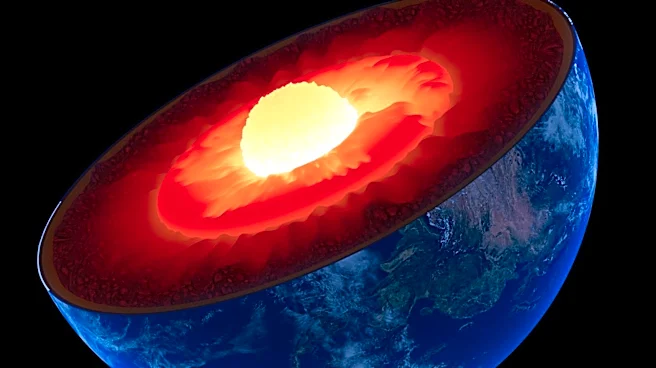
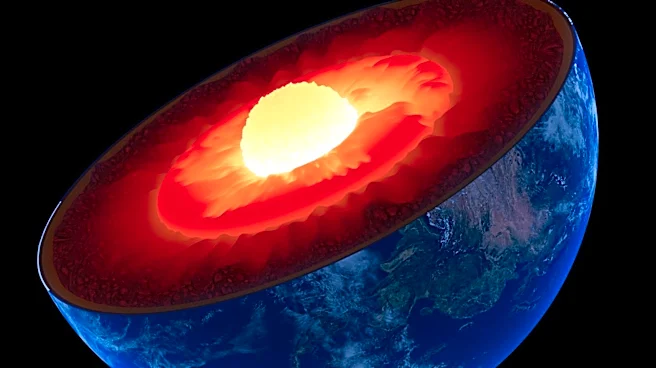
the Grand Canyon and across Europe, Australia, Africa, and Asia, involves vast gaps where older rock layers are directly topped by much younger ones, with hundreds of millions to over a billion years of expected sedimentary layers absent. A new study published in the journal Nature, led by Santosh Dhungana and co-authored by Nicolas Flament, suggests that activity deep within Earth's mantle is responsible. Using computer models, they found that the slow circulation of hot rock in the mantle caused major ancient continental regions, including Laurentia (modern North America), Baltica (northern Europe), and North China, to be pushed upwards during the Neoproterozoic Era (approximately one billion to 540 million years ago). This uplift exposed vast land areas to prolonged weathering and erosion, wearing away older rock. Subsequently, these regions began to sink, allowing younger sediments to accumulate over the eroded surfaces, creating the sharp geological divide seen today.
Why It's Important?
This research offers a significant advancement in understanding Earth's geological history, particularly for North America where the Grand Canyon provides a prominent example of the Great Unconformity. By linking deep mantle dynamics to surface geological features, the study provides a more comprehensive framework for interpreting the planet's past. This understanding is crucial for geologists and paleontologists in reconstructing ancient environments, climate patterns, and the evolution of life. The findings could lead to a re-evaluation of existing geological models and improve our ability to predict future geological processes. For the U.S., specifically, understanding the forces that shaped its continental landmasses has implications for resource exploration, seismic hazard assessment, and the study of long-term environmental change.
What's Next?
The findings from this study will likely prompt further research into the specific mechanisms of mantle convection and its impact on continental uplift and subsidence. Geologists may re-examine other instances of unconformities globally to see if similar mantle-driven processes can explain them. Future studies could involve more detailed computer modeling, incorporating additional geological and geophysical data to refine the proposed timeline and extent of these events. This research could also influence how geological surveys are conducted and how ancient rock formations are interpreted, potentially leading to new discoveries about Earth's deep past and the forces that continue to shape its surface.
Beyond the Headlines
The Great Unconformity represents a profound 'missing chapter' in Earth's story, and this new explanation highlights the dynamic and interconnected nature of our planet's systems, from its deep interior to its surface. It underscores the immense timescales over which geological processes operate and the powerful, often unseen, forces that sculpt continents. This discovery also serves as a reminder of the incompleteness of the geological record and the challenges inherent in reconstructing Earth's history. The concept of a 'missing billion years' can inspire broader philosophical reflections on time, change, and the limits of human understanding when confronted with planetary-scale phenomena, fostering a deeper appreciation for the complex history of our home planet.