




What's Happening?
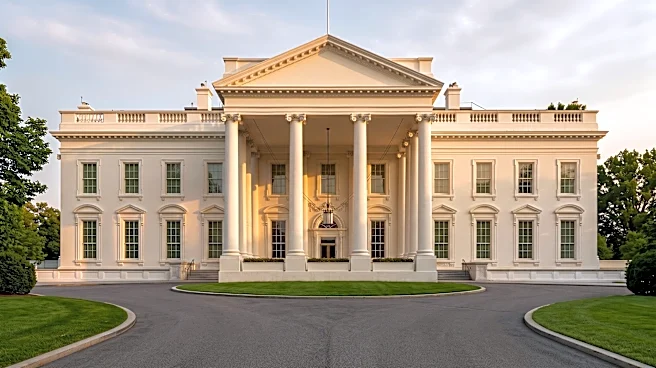
President Trump's upcoming summit with Chinese President Xi Jinping on September 24 at the White House is generating concerns among U.S. foreign policy experts regarding its potential impact on Taiwan's security. Critics suggest that President Trump's 'deal-making
instincts' and perceived disinterest in strategic nuances could lead to concessions on Taiwan. This follows a pattern observed in his second term, where his rhetoric and actions have been interpreted as a shift away from the long-standing U.S. policy of 'strategic ambiguity' towards Taiwan. During a previous meeting in May, President Trump reportedly criticized Taiwan's leadership as 'dangerous separatists' and has viewed arms sales to Taiwan as a bargaining chip in negotiations with Beijing. This approach contrasts with past administrations that deliberately siloed Taiwan's defense from broader China policy, raising fears that the U.S. commitment to Taiwan's defense is weakening.
Why It's Important?
The potential erosion of 'strategic ambiguity' regarding Taiwan is a critical development with significant geopolitical implications. This policy, designed to deter China from using force against Taiwan while also preventing Taiwan from provoking Beijing, has been a cornerstone of stability in the Indo-Pacific for decades. A perceived weakening of U.S. support could embolden China to act more aggressively towards Taiwan, increasing the risk of conflict. For the U.S., maintaining stability in the Taiwan Strait is vital for its economic interests, given Taiwan's crucial role in the global technology supply chain, particularly in semiconductor manufacturing. Furthermore, a conflict over Taiwan would have severe repercussions for regional security, potentially drawing in U.S. allies and disrupting global trade. The shift in President Trump's approach also signals a potential re-evaluation of U.S. alliances and commitments in Asia, which could have long-term consequences for American influence and credibility on the international stage.
What's Next?
The upcoming summit will be closely watched for any indications of further shifts in U.S. policy towards Taiwan. While formal policy changes may not be immediately announced, President Trump's rhetoric and any agreements reached with Xi Jinping could signal a de facto change in the U.S. stance. This could lead to increased anxiety in Taipei and among U.S. allies in the region. There is a possibility that the administration might continue to use arms sales to Taiwan as leverage in broader negotiations with China, rather than treating them as a consistent commitment to Taiwan's defense. Conversely, some analysts suggest that Beijing might be content with the current 'constructive and stable relationship' and may not seek to immediately test U.S. resolve, especially with Xi Jinping potentially focused on securing a fourth term. However, the long-term trajectory points towards increased uncertainty and potential instability in the Taiwan Strait, requiring careful diplomatic navigation from all parties.
Beyond the Headlines
The debate surrounding 'strategic ambiguity' and President Trump's approach to Taiwan delves into the core principles of U.S. foreign policy and its role in maintaining global order. The policy's original intent was to manage complex geopolitical realities, balancing deterrence with restraint. Any departure from this delicate balance could have far-reaching consequences, not just for Taiwan but for the broader international system. It raises questions about the reliability of U.S. security commitments and the future of democratic values in the face of authoritarian expansion. The economic dimension is also critical, as Taiwan's advanced technology sector is deeply integrated into the global economy. A disruption there would have ripple effects worldwide, impacting everything from consumer electronics to national defense capabilities. Ultimately, the evolving U.S. approach to Taiwan under President Trump could signify a fundamental reordering of power dynamics in Asia and a test of the international community's commitment to established norms and principles.