
What's Happening?
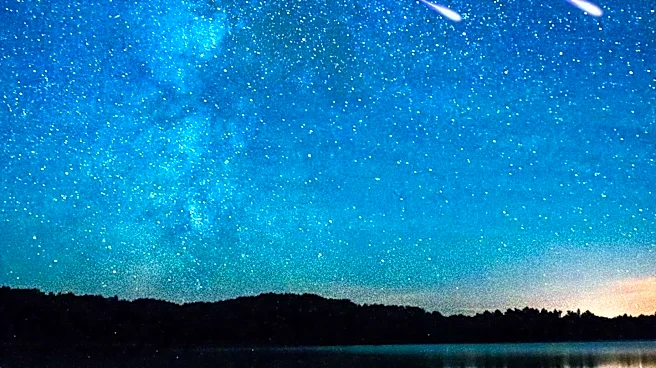
April presents a unique opportunity for stargazers as Venus and Jupiter dominate the evening sky. Venus, often called Earth's 'sister planet,' is visible in the west-northwest, while Jupiter, the largest
planet in the solar system, appears in the south-southwest. These planets are easily observable without specialized equipment, offering a brilliant display for both amateur and seasoned astronomers. Additionally, Mercury and Mars are visible in the early morning hours, with a special alignment of Mercury, Mars, Saturn, and a crescent moon occurring on April 16. This month also features Venus passing near the Pleiades star cluster on April 23, providing a rare spectacle for observers.
Why It's Important?
The visibility of these celestial events provides an accessible way for the public to engage with astronomy, fostering interest in space science and education. Such events can inspire future generations to pursue careers in STEM fields. Moreover, the alignment of planets and their visibility from Earth offer scientists valuable opportunities to study planetary movements and characteristics. This can enhance our understanding of the solar system and contribute to ongoing research in planetary science.
What's Next?
As the month progresses, Venus will continue to ascend higher in the sky, becoming more prominent. Observers can expect to see its crescent shape more clearly through telescopes. Jupiter will remain a key feature in the evening sky, with its cloud bands and moons visible to those with telescopes. The alignment of Mercury, Mars, Saturn, and the moon on April 16 will be a highlight for early risers, while the Venus-Pleiades conjunction on April 23 will attract both casual and dedicated stargazers.