







What's Happening?
New research suggests that Pluto's atmosphere is beginning to collapse, with a 16% drop in pressure observed in its lower atmosphere between 2022 and 2023. This finding, published in The Planetary Science Journal, is based on a comprehensive analysis
of stellar occultation data collected from 1988 to 2023. Amanda Sickafoose, a planetary scientist at the Planetary Science Institute, led the study, which compiled and re-analyzed data from over 15 telescope sites globally. The data indicates that while the upper atmosphere remains clear, haze in the lower atmosphere has started to dissipate, likely due to haze particles snowing down as Pluto cools. This atmospheric change is attributed to Pluto's highly noncircular orbit and its drastic temperature fluctuations as it moves closer to and farther from the Sun. Astronomers have long theorized that Pluto's nitrogen-dominated atmosphere could freeze out during its long winter, and these recent observations suggest this process may now be underway.
Why It's Important?
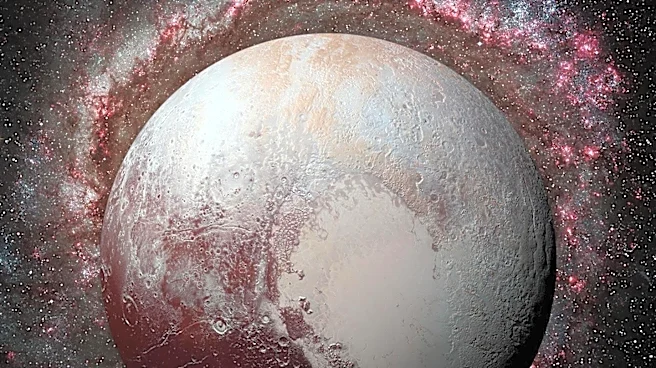
This potential atmospheric collapse on Pluto is significant for several reasons. As the best-studied trans-Neptunian object (TNO), Pluto serves as a crucial reference point for understanding other distant celestial bodies. The observed changes provide real-world data to validate or refine atmospheric models that predict how TNOs behave under extreme temperature variations. The rapid 16% pressure drop over just a few years, a small fraction of Pluto's 248-year orbit, indicates a dynamic and active process of ice condensation. This phenomenon offers unique insights into the exchange of nitrogen particles between Pluto's atmosphere and its surface ice, particularly in regions like the heart-shaped Tombaugh Regio. Understanding these processes can help scientists better comprehend the formation and evolution of atmospheres on other icy dwarf planets and potentially exoplanets in similar cold, distant environments.
What's Next?
Astronomers anticipate that Pluto's atmospheric pressure will continue to drop for more than 150 years, with a potential rebound in the 23rd century, according to current models. The next critical opportunity for high-quality occultation observations is scheduled for 2027. These future observations will be crucial for verifying whether the atmospheric collapse is indeed imminent and for tracking its progression. Pinpointing the timing and rate of this collapse will provide valuable clues about where atmospheric nitrogen is condensing and forming snow deposits on Pluto's southern hemisphere. Continued monitoring through stellar occultations, a powerful tool for observing the distant solar system from Earth, will be essential for further understanding this unique atmospheric phenomenon and its implications for planetary science.
Beyond the Headlines
The observed atmospheric changes on Pluto highlight the complex and dynamic nature of celestial bodies, even those far from the Sun. This discovery challenges the notion of static planetary environments and underscores the importance of long-term observational studies. The concept of an atmosphere 'collapsing' into 'nitrogen snow' offers a vivid illustration of extreme planetary weather and geological processes. Furthermore, the study's success in re-analyzing decades of data from various sources with consistent methodology demonstrates the power of collaborative science and advanced data processing in overcoming observational challenges. This approach could be applied to other astronomical mysteries, potentially revealing subtle changes in distant objects that were previously obscured by data inconsistencies. The ongoing study of Pluto's atmosphere provides a natural laboratory for understanding fundamental principles of atmospheric physics and planetary evolution under conditions vastly different from Earth's.