



What's Happening?
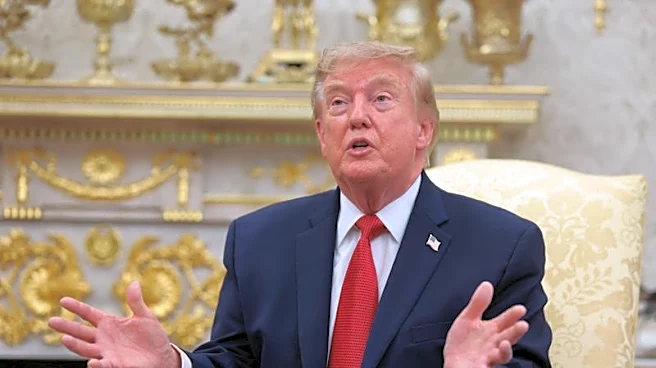
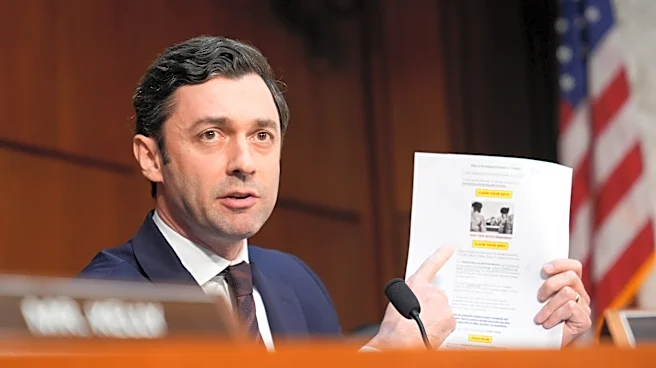
As the midterm elections draw nearer, President Trump and Senator Jon Ossoff are presenting two starkly different visions for the future of America. Speaking in Atlanta, Senator Ossoff launched a strong critique of President Trump's economic policies,
pointing to rising costs for essential goods like groceries, utilities, and school supplies, and attributing them to President Trump's leadership. He also criticized President Trump for starting and failing to resolve a war in Iran, framing the upcoming election as a referendum on corruption, economic hardship, and perceived global leadership failures. Conversely, at a rally in Long Island, President Trump asserted his presidency as a historic success and attacked Democrats, accusing them of aiming to transform America into a 'communist country' and of undermining law enforcement. President Trump also defended the ongoing war in Iran, suggesting that paying 'a tiny little bit more' for gasoline was a worthwhile trade-off to prevent Iran from developing nuclear weapons, a statement that risks alienating voters concerned about affordability. His rhetoric also included controversial remarks about 'jihadists being elected,' following the primary victory of Abdul El-Sayed, a Muslim public health professional, and echoing past criticisms of Rep. Ilhan Omar. The article also highlights ideological rifts within the Democratic party, with progressives like Rep. Ro Khanna advocating for Medicare-for-All, while Democratic leader Rep. Hakeem Jeffries distances himself from more radical policies such as defunding the police or open borders, a division Republicans hope to exploit.
Why It's Important?
The emergence of sharply contrasting narratives from President Trump and Senator Ossoff underscores the profound political polarization gripping the United States as the midterm elections approach. President Trump's strategy of portraying Democrats as 'un-American extremists' is a calculated effort to galvanize his base, a critical component for Republican turnout in midterm cycles when the presidential candidate is not on the ballot. Senator Ossoff's focus on tangible economic hardships, such as the rising cost of living and gasoline prices, provides a concrete and relatable argument for voters grappling with inflation, aiming to connect President Trump's policies directly to their daily struggles. President Trump's comments regarding the Iran war and the cost of gasoline risk alienating moderate and independent voters, who are often swayed by economic concerns, thereby complicating his campaign's efforts to broaden his coalition. Furthermore, the visible ideological divisions within the Democratic party, particularly between its progressive and moderate factions on key policy issues, could undermine party unity and provide Republicans with a strategic opening to exploit these internal rifts. The outcome of these midterm elections will be pivotal, as it will significantly shape the legislative agenda, determine the balance of power in Congress, and set the political tone for the nation leading into the next presidential election cycle.
What's Next?
The upcoming midterm elections will serve as a crucial barometer for which political vision resonates most strongly with the American electorate. Both major parties are expected to intensify their campaign efforts, strategically targeting key battleground states and working to mobilize their core supporters while simultaneously attempting to sway undecided voters. President Trump is anticipated to continue employing his aggressive campaign tactics, emphasizing cultural wedge issues and portraying Democratic opponents as radical. Conversely, Democrats will likely persist in highlighting economic anxieties and endeavoring to link Republican candidates to President Trump's perceived policy failures and his overall unpopularity. The internal ideological debates within the Democratic party may become more pronounced as candidates strive to differentiate themselves or coalesce around a unified message. The results of these elections will directly determine the composition of Congress, potentially leading to significant shifts in policy priorities, periods of legislative gridlock, or, depending on the electoral margins, new opportunities for bipartisan cooperation on critical national issues.
Beyond the Headlines
This intense political climate reflects a deeper, ongoing struggle over the fundamental identity and future trajectory of the United States, encompassing divergent views on economic philosophy, social values, and foreign policy. President Trump's rhetoric, including his characterizations of 'communists' and 'jihadists' being elected, contributes to an increasingly charged political environment, which risks exacerbating existing social divisions and eroding public trust in democratic institutions. The contentious debate surrounding the Iran war and its economic repercussions highlights the persistent challenge of sustaining public support for foreign interventions, particularly when domestic economic concerns are paramount for many citizens. The internal struggle within the Democratic party, balancing progressive ideals with moderate pragmatism, serves as a microcosm of the party's continuous effort to define its platform and appeal to a broad and diverse electorate. The reliance on strong, often inflammatory, rhetoric from both political factions suggests a continuing trend of politics as a culture war, where persuasion is less about detailed policy proposals and more about identity, allegiance, and emotional appeals. The outcome of these midterms could therefore signal whether the electorate is more responsive to populist appeals and cultural grievances or to arguments centered on economic stability and traditional governance.