



What's Happening?
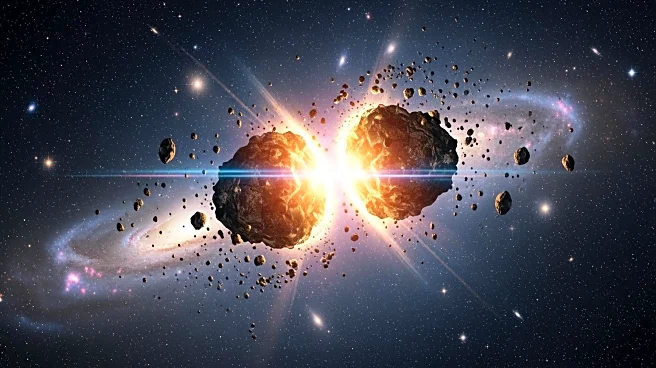
NASA's Hubble Space Telescope has achieved a significant milestone by capturing images of a collision between asteroids in the Fomalhaut star system, located 25 light-years from Earth. This event marks the first time such a collision has been directly
observed in an exoplanetary system. The collision resulted in a massive debris cloud, providing a rare opportunity to study the dynamics of planetesimal interactions. The Fomalhaut system, known for its bright star and dusty debris belts, has been a subject of interest since 2008 when a candidate planet was discovered using Hubble. However, recent observations suggest that what was thought to be a planet is actually a dust cloud formed by colliding planetesimals. The discovery of a second debris cloud, named 'cs2', near the first, 'cs1', has intrigued scientists, as such events are expected to occur only once every 100,000 years.
Why It's Important?
This discovery is crucial for understanding the formation and evolution of planetary systems. The ability to observe such collisions provides insights into the size and composition of the colliding bodies, which are estimated to be about 37 miles across. The Fomalhaut system serves as a natural laboratory for studying these processes, offering clues about the materials and conditions that lead to planet formation. Additionally, the findings highlight the challenges future space missions may face in distinguishing between dust clouds and actual planets, as these clouds can mimic the appearance of planets in reflected starlight. This underscores the need for careful analysis in the search for exoplanets.
What's Next?
Researchers plan to continue monitoring the cs2 debris cloud using Hubble over the next three years to observe its evolution. They aim to determine whether the cloud will fade or become brighter as it interacts with other material in the debris belt. The James Webb Space Telescope will also be utilized to provide additional data, including the size and composition of the dust grains. These observations will help refine models of planetary system development and improve techniques for detecting exoplanets.