





What's Happening?
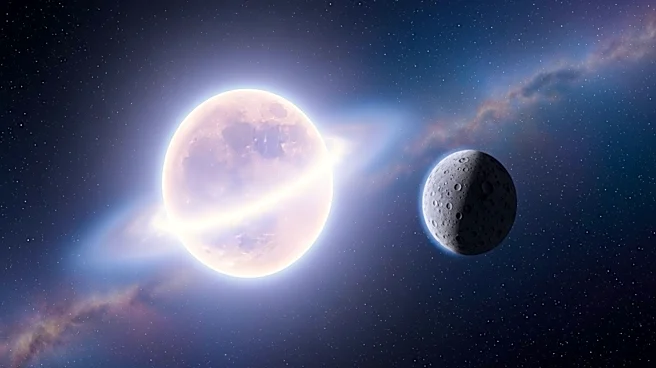
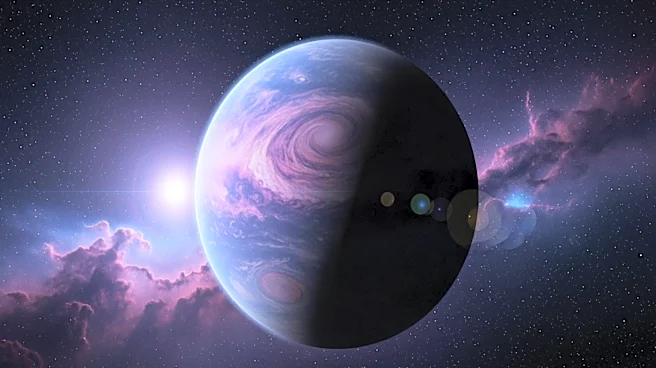
Astronomers have identified a unique giant planet, TOI-5205 b, which is nearly the size of Jupiter and orbits a small, cool red dwarf star. This discovery, made using the James Webb Space Telescope, challenges current theories about planet formation,
as such large planets are not expected to form so close to low-mass stars. The study, led by Caleb Cañas of NASA Goddard Space Flight Center and Shubham Kanodia of Carnegie Science, reveals that TOI-5205 b has a lower concentration of heavy elements in its atmosphere compared to Jupiter and its host star. This finding suggests that the planet's heavy elements may have migrated inward during its formation, resulting in a carbon-rich, oxygen-poor atmosphere.
Why It's Important?
The discovery of TOI-5205 b is significant as it challenges existing models of planetary formation, particularly around low-mass stars. Understanding how such 'forbidden' planets form could reshape scientific theories about the early development of planetary systems. This research could have broader implications for the study of exoplanets and the conditions that lead to their formation. The findings may also influence future astronomical research and the search for life beyond Earth, as they provide new insights into the diversity and complexity of planetary systems.
What's Next?
Further observations of TOI-5205 b and similar systems are planned to better understand the formation of these 'forbidden' worlds. The research is part of the 'Red Dwarfs and the Seven Giants' program, which uses the James Webb Space Telescope to study giant exoplanets around M-dwarf stars. These studies aim to clarify the processes that lead to the formation of large planets in unexpected environments, potentially leading to new models of planetary system development.