





What's Happening?
A study conducted by Tel Aviv University researchers has documented rare instances of spontaneous cooperation between two female western lowland gorillas at the Ramat Gan Safari. The study, published in the scientific journal Primates, details how two half-sister
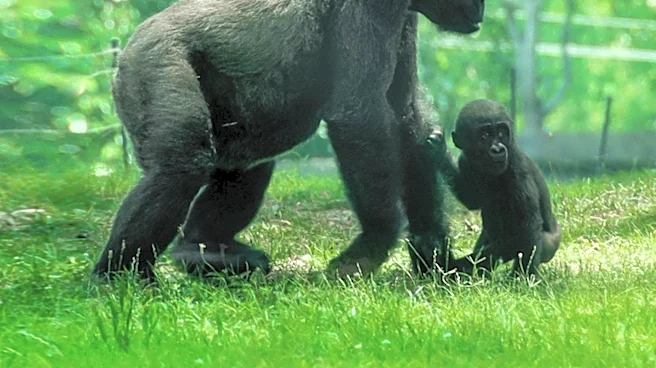
gorillas, Amelia and Lisha, formed a 'living ladder' to reach otherwise inaccessible high branches for food. Researchers observed three such incidents in 2021, 2024, and 2025. In these instances, Lisha would position herself on all fours, allowing Amelia to climb onto her back to reach vegetation approximately 15 feet above the ground, bypassing an electric barrier. The most detailed observation occurred in September 2024, when keepers found the gorillas eating bark and leaves from a previously out-of-reach branch. Security camera footage confirmed Amelia climbing onto Lisha's back to break off the branch. The gorillas were not trained for this behavior, and Lisha appeared to actively and willingly participate without physical guidance from Amelia, suggesting true cooperation rather than one gorilla being used as a tool.
Why It's Important?
This study is significant as it provides a rare example of spontaneous cooperation between adult gorillas, highlighting complex problem-solving abilities and social intelligence in these primates. The findings challenge previous understandings of gorilla social dynamics, particularly because the half-sisters do not typically spend much time together, suggesting that coordinated behavior can occur even without consistently close social bonds. This observation contributes to a broader understanding of primate cognition and behavior, offering insights into the evolutionary roots of cooperation. For primatology, it underscores the need for continued observation of animal behavior in varied settings to uncover the full spectrum of their capabilities. The study also notes that while cooperation occurred, food sharing was not consistent, indicating that cooperative acts do not always lead to equitable distribution of resources.
What's Next?
Future research will likely aim to observe more instances of such cooperative behavior in other gorilla populations, both in captivity and in the wild, to determine if this is an isolated occurrence or a more widespread, albeit rare, behavior. Researchers may also investigate the subtle cues or communication methods the gorillas might be using, even without explicit language or preplanning, to coordinate their actions. Further studies could explore the environmental factors or specific social dynamics that might trigger such cooperative problem-solving. The findings could also inspire new approaches to primate enrichment in zoos, encouraging environments that foster and allow for the expression of complex social behaviors. Additionally, the study's implications for understanding human evolution, particularly how early humans might have survived through social support and cooperation, could be further explored.
Beyond the Headlines
The study's implications extend beyond primatology, offering valuable insights into the evolution of cooperation in humans. Prof. Israel Hershkovitz suggests these observations provide a partial explanation for human survival on the savanna, emphasizing social support and high levels of cooperation even in the absence of language or preplanning. This challenges the notion that complex cooperation is solely a human trait or requires advanced cognitive abilities like language. The distinction between using another individual as a tool and true cooperation, as highlighted by Michael Levitzky, prompts deeper ethical and philosophical questions about animal agency and intentionality. It encourages a re-evaluation of our expectations of animal capabilities, as noted by Yehonatan Samocha, head of the primate section at the Ramat Gan Safari. The study, while based on limited incidents, opens avenues for understanding the fundamental drivers of collaborative behavior across species, potentially informing our understanding of social structures and problem-solving in diverse biological contexts.