



What's Happening?
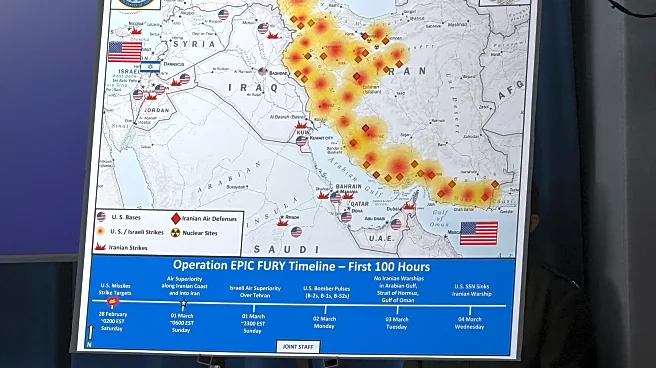
The U.S. military has requested assistance from mining companies to boost domestic supplies of 13 critical minerals essential for manufacturing semiconductors, weapons, and other products. This request was made a day before the U.S. and Israel launched
strikes on Iran, highlighting Washington's ongoing efforts to secure materials crucial for warfare. The Pentagon has reached out to the Defense Industrial Base Consortium (DIBC), which includes over 1,500 companies and universities, asking for proposals by March 20 to mine, process, or recycle these minerals. The list includes arsenic, bismuth, gadolinium, germanium, graphite, hafnium, nickel, samarium, tungsten, vanadium, ytterbium, yttrium, and zirconium. The U.S. heavily relies on imports for these minerals, with China being a dominant producer. Companies like Guardian Metal Resources and American Tungsten are planning to apply for funding to develop their projects in Nevada and Idaho, respectively.
Why It's Important?
The Pentagon's initiative underscores the strategic importance of securing a domestic supply of critical minerals, which are vital for national security and economic stability. The reliance on imports, particularly from China, poses a risk to the U.S. supply chain, especially given the geopolitical tensions and export restrictions imposed by China on some of these minerals. The development of domestic sources could reduce dependency on foreign suppliers and enhance the U.S.'s ability to produce essential military and technological components. This move could also stimulate the U.S. mining industry, potentially leading to job creation and technological advancements in mineral processing.
What's Next?
The Pentagon's request for proposals is likely to spur a wave of applications from companies seeking to capitalize on the opportunity to develop domestic mineral resources. The U.S. government may provide significant funding, ranging from $100 million to over $500 million, to support these projects. This could lead to increased exploration and development activities in the U.S. mining sector. Additionally, the focus on securing critical minerals may prompt further policy discussions and legislative actions aimed at strengthening the U.S. supply chain and reducing reliance on foreign imports.
Beyond the Headlines
The push for domestic mineral supply raises questions about environmental and regulatory challenges associated with mining activities. Balancing the need for critical minerals with environmental protection and community impacts will be crucial. Moreover, the geopolitical implications of reducing dependency on Chinese imports could affect international relations and trade dynamics. The initiative may also drive innovation in recycling and processing technologies, contributing to more sustainable practices in the mining industry.