



What's Happening?
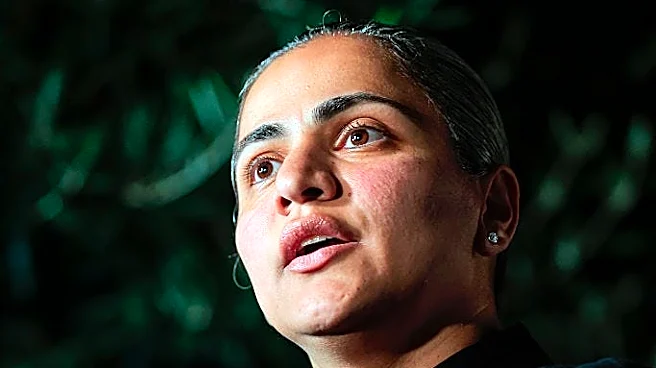
Xavier Becerra, the Democratic candidate for California governor, is taking a notably cautious approach in his campaign, largely refraining from making specific policy promises or setting ambitious goals. This strategy contrasts sharply with his Republican
opponent, Steve Hilton, who has outlined numerous detailed policies, and even with current Governor Gavin Newsom, who campaigned on lofty objectives. Becerra attributes his deliberative style to a 'pivotal lesson' learned from his experience with the North American Free Trade Agreement in 1993, where he felt American jobs were displaced despite his efforts to include labor protections. He emphasizes that he will not support anything until he is 'sure' of its implications. Instead of concrete pledges, Becerra points to his extensive record in public service, including a dozen terms in Congress, serving as California's first Latino state attorney general, and as the first Latino U.S. Secretary of Health and Human Services, as proof of his capability to lead the state. He prefers to offer voters a 'steady hand' in government rather than potentially 'inflated promises.'
Why It's Important?
Becerra's cautious campaign strategy is significant for several reasons. Firstly, it reflects a calculated political maneuver in a state where Democrats hold a substantial voter registration advantage, suggesting he may not feel the need to energize the base with bold promises. This approach could be seen as a way to minimize potential missteps and avoid alienating any segment of the broad Democratic coalition. Secondly, it highlights a potential shift in political campaigning, where a candidate with a strong lead might prioritize a 'safe' image over a 'visionary' one. This could influence how future candidates in similar electoral landscapes approach their campaigns. Thirdly, his reluctance to commit to specific targets, such as housing units or timelines for phasing out gas cars, could lead to criticism from those seeking clear solutions to California's pressing issues. However, it also positions him as a 'pragmatic progressive,' willing to adapt his agenda based on feasibility and stakeholder input, rather than ideological purity. This strategy could appeal to voters who are wary of unfulfilled promises from past administrations.
What's Next?
As the November election approaches, Becerra is expected to continue his strategy of emphasizing his experience and a steady approach to governance, rather than making grand policy commitments. Political analysts suggest that his primary goal will be to sufficiently motivate liberal voters to turn out, given the Democratic voter registration advantage in California. His campaign will likely focus on his past achievements and his reputation as a thorough decision-maker. However, he may face continued pressure from the media and his opponent to articulate more specific plans for addressing key state challenges like housing, healthcare, and climate change. His 'power hour' proposal for low-income utility customers, which he is considering making a promise, indicates a potential willingness to offer limited, achievable policy ideas. The outcome of the election will serve as a test of whether a cautious, experience-driven campaign can succeed in a politically polarized environment, especially when contrasted with an opponent offering numerous specific, albeit ambitious, proposals.
Beyond the Headlines
Becerra's campaign strategy delves into the deeper philosophical debate about the role of promises in political campaigns and the nature of leadership. His 'pivotal lesson' from NAFTA suggests a profound impact of past political experiences on his current approach, highlighting how personal history can shape a politician's risk aversion. This cautiousness, while potentially pragmatic, could also be interpreted as a lack of bold vision or a reluctance to tackle complex issues head-on. The contrast with Governor Newsom's unfulfilled 'lofty goals' raises questions about the efficacy of ambitious promises versus a more incremental, achievable approach to governance. Furthermore, Becerra's past actions, such as his initial refusal to release police misconduct records until judicial clarity, illustrate a pattern of prioritizing legal certainty and thorough deliberation, even when facing public and media pressure. This approach, while ensuring legal compliance, could also be seen as hindering transparency or delaying necessary reforms. His 'pragmatic progressive' label suggests a willingness to compromise and adapt, which could be a strength in navigating complex political landscapes but might also disappoint those seeking more radical change.