



What's Happening?
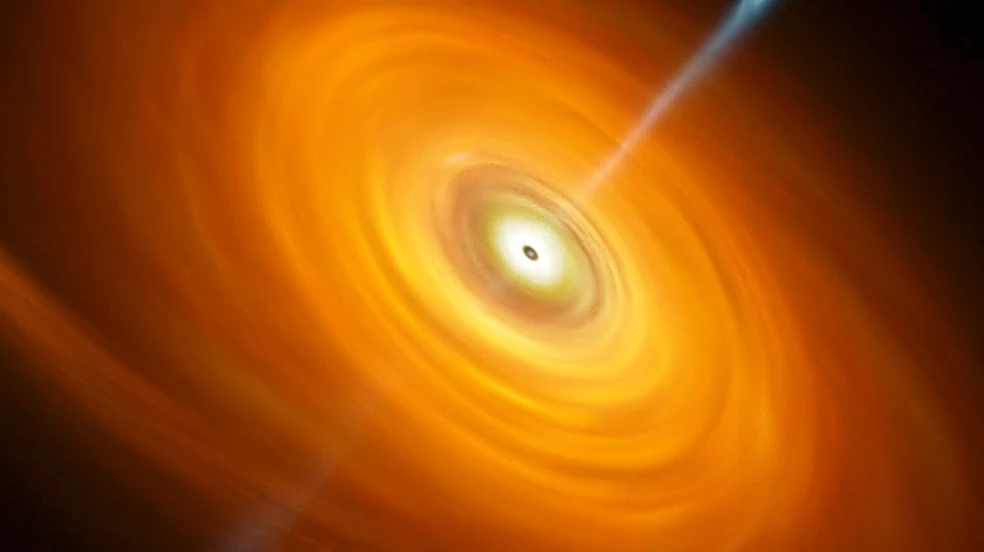
Researchers at the Technion-Israel Institute of Technology have found evidence suggesting that powerful eruptions near supermassive black holes are driven by the same magnetic processes responsible for solar storms. This discovery, published in The Astrophysical
Journal Letters, provides new insights into extreme cosmic environments. The team observed a supermassive black hole at the center of the galaxy NGC 3783, identifying a pattern of X-ray emissions known as the Neupert effect. This effect, first observed on the Sun in 1968, describes a relationship between different types of X-ray emissions during a flare, indicating that magnetic reconnection is the energy release mechanism. This marks the first time the Neupert effect has been detected in the vicinity of a black hole. Additionally, the observations revealed an ultrafast outflow of material from the black hole's surrounding region, similar to coronal mass ejections (CMEs) from the Sun.
Why It's Important?
This research establishes a surprising connection between phenomena occurring on our Sun and those in the extreme environments around supermassive black holes, which are millions of times more massive. It suggests that fundamental physical processes, specifically magnetic reconnection, operate across vastly different scales and conditions in the universe. Understanding these processes is crucial for comprehending how energy is released in cosmic events, from solar flares that can impact Earth's technology to powerful eruptions from active galactic nuclei. The findings could lead to a more unified theory of high-energy astrophysical phenomena, bridging the gap between solar physics and black hole astrophysics. This deeper understanding can also help predict and mitigate potential impacts of solar storms on Earth and inform our models of galaxy evolution.
Beyond the Headlines
The discovery that magnetic reconnection drives eruptions in both solar storms and black hole coronae has profound implications for our understanding of plasma physics in extreme environments. It suggests a universality in the underlying physical mechanisms governing energy release in magnetized plasmas, regardless of the gravitational forces or scales involved. This could lead to advancements in theoretical models that describe how magnetic fields interact with matter under intense conditions, which are difficult to replicate in terrestrial laboratories. Furthermore, the ability to detect patterns like the Neupert effect in distant galaxies opens up new observational techniques for studying black hole activity and the dynamics of accretion disks. This could ultimately refine our understanding of how black holes grow and influence their host galaxies over cosmic timescales.