
What's Happening?
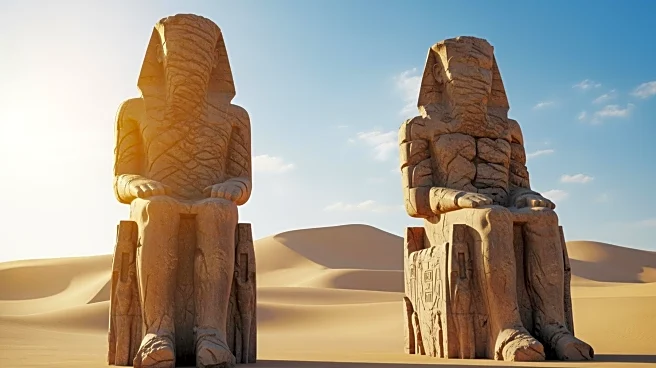
Egypt has unveiled the restoration of two colossal statues of Pharaoh Amenhotep III in Luxor, marking a significant archaeological event aimed at enhancing tourism. The statues, known as the Colossi of Memnon,
were reassembled after a two-decade-long renovation project. These statues, originally toppled by an earthquake around 1200 BC, have been reconstructed by an Egyptian-German team led by Egyptologist Hourig Sourouzian. The statues depict Amenhotep III seated with his hands on his thighs, facing east towards the Nile. This restoration is part of a broader effort to revive the grandeur of Amenhotep III's funerary temple, which was one of the largest and richest in ancient Egypt.
Why It's Important?
The restoration of the Colossi of Memnon is crucial for Egypt's tourism sector, which is a significant contributor to the country's economy. The unveiling comes shortly after the opening of the Grand Egyptian Museum, both of which are part of Egypt's strategy to attract more tourists. The tourism industry, heavily reliant on Egypt's rich archaeological heritage, has faced challenges due to political instability and the COVID-19 pandemic. However, recent efforts to restore and promote historical sites are expected to boost tourist numbers, with projections of 18 million visitors this year and hopes for 30 million annually by 2032. This increase in tourism is vital for economic recovery and growth.
What's Next?
Following the unveiling, Egypt anticipates a surge in tourist interest in Luxor and other archaeological sites. The government plans to continue its focus on restoring and promoting historical sites to sustain and increase tourist inflow. The success of these initiatives could lead to further investments in the tourism infrastructure, enhancing Egypt's global cultural and historical appeal. Additionally, the ongoing restoration projects may encourage international collaborations in archaeology and heritage conservation.