



What's Happening?
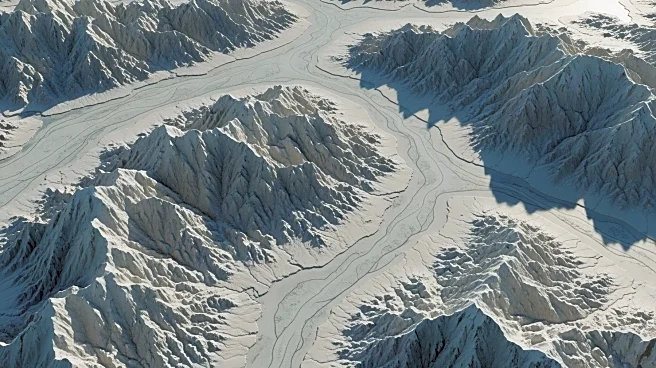
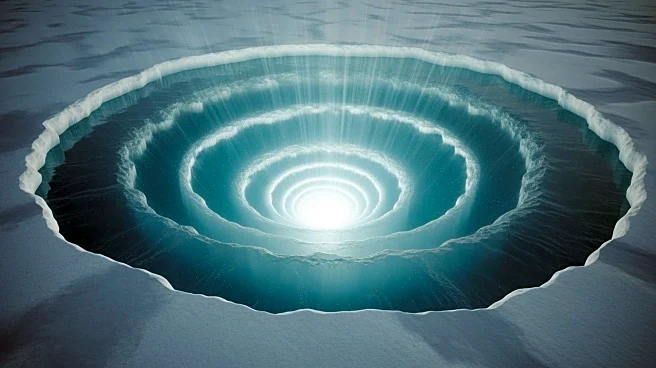
Recent geophysical research has identified a phenomenon known as the Antarctic Gravity Hole, a large gravitational anomaly located in Antarctica. This anomaly is characterized by a slight dip in Earth's gravitational field, forming a bowl-shaped area
where gravity is weaker than expected. The anomaly, formally called the Antarctic Geoid Low, is believed to be the planet's deepest gravitational valley. It results from deep mantle rock movements and remnants of ancient tectonic plates. The research, led by geophysicist Alessandro Forte, utilized seismic tomography and computer modeling to map the Earth's interior and understand the anomaly's formation. The study suggests that the anomaly has been shaped over tens of millions of years by the sinking of ancient tectonic plates into the mantle, causing a redistribution of mass and affecting gravity.
Why It's Important?
The Antarctic Gravity Hole provides significant insights into the interactions between Earth's deep interior processes and surface climate changes. The anomaly's persistence over millions of years suggests stable deep mantle structures that influence surface conditions. Understanding these interactions is crucial as they may impact sea levels and the distribution of ocean water, potentially affecting the growth or retreat of ice sheets. This research highlights the interconnectedness of mantle circulation, tectonics, and climate, offering a deeper understanding of Earth's dynamic systems. The findings could inform future studies on how deep-Earth processes influence climate and environmental changes, which is vital for predicting long-term climate patterns and their effects on global sea levels.
What's Next?
Future research will likely focus on further exploring the connections between deep-Earth processes and surface climate changes. Scientists aim to understand how mantle convection patterns might evolve and their potential impact on oceans and ice sheets. This could involve more detailed seismic studies and advanced computer modeling to simulate geological changes over time. Additionally, researchers may investigate the implications of these findings for predicting future climate scenarios and their effects on global sea levels. Understanding these processes could also inform policy decisions related to climate change mitigation and adaptation strategies.
Beyond the Headlines
The Antarctic Gravity Hole underscores the complexity of Earth's systems, where deep geological processes can have subtle yet significant impacts on surface conditions. This research challenges the perception of Earth as a static entity, revealing the dynamic nature of its interior. The study also raises questions about the potential for deep-Earth processes to influence climate and environmental changes in ways not yet fully understood. As scientists continue to unravel these connections, the findings could lead to a paradigm shift in how we understand and address climate change, emphasizing the need for a holistic approach that considers both surface and deep-Earth dynamics.