





What's Happening?
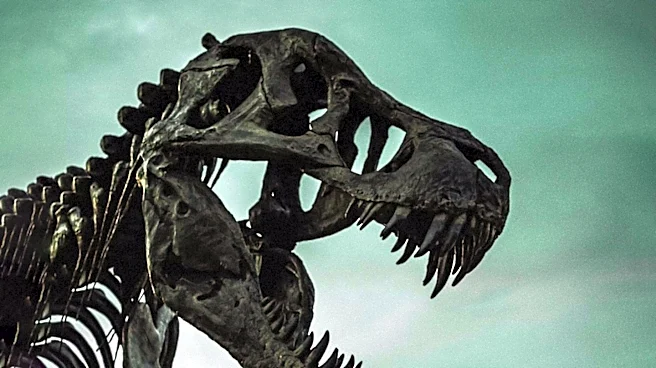
Archaeologists in northeastern Wyoming have discovered intriguing bite marks on Edmontosaurus annectens fossils, leading to new insights into the behavior of the Tyrannosaurus rex. A study led by paleontologist Bethania CT Siviero from Loma Linda University
analyzed over 3,000 bone samples, identifying 12 with tooth marks. Four of these samples bore distinctive marks attributed to the T. rex, suggesting its role as both a predator and scavenger. The absence of healing on these marks indicates the T. rex likely fed on carcasses rather than live prey. This research not only highlights the T. rex's scavenging behavior but also establishes a method to differentiate between genuine tooth marks and environmental damage.
Why It's Important?
This discovery provides a more nuanced understanding of the T. rex's ecological role, challenging the traditional view of it as solely a top predator. By demonstrating its scavenging habits, the study offers insights into the prehistoric ecosystem and the T. rex's adaptability. This could influence how paleontologists interpret fossil evidence and reconstruct ancient food webs. The findings also underscore the importance of developing accurate methods to analyze fossilized remains, which can lead to more precise reconstructions of dinosaur behavior and interactions.