







What's Happening?
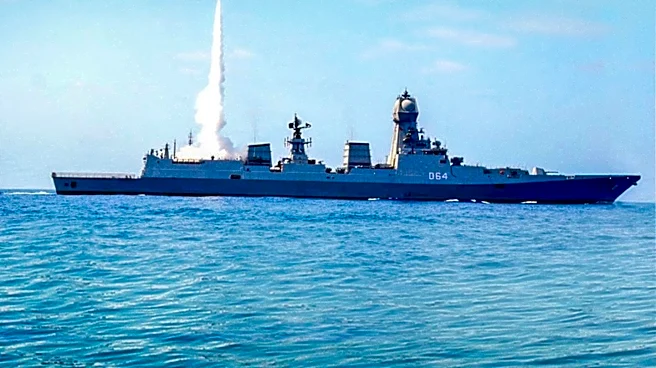
India and Indonesia have formalized a significant defense trade agreement involving the transfer of BrahMos cruise missiles and an unspecified air-to-air missile. This development marks a major expansion of India's missile exports in Southeast Asia. The
agreements were announced during Indian Prime Minister Narendra Modi's state visit to Jakarta on July 7. The deal includes cooperation in joint research, co-production of defense technologies, port calls, and hydrographic activities. While details of the air-to-air missile remain undisclosed, it is speculated to be the Astra beyond-visual-range air-to-air missile, developed by India's Defence Research and Development Organisation and produced by Bharat Dynamics Limited. The BrahMos agreement covers the land-based coastal-defense variant, which Indonesia has been pursuing for several years.
Why It's Important?
This agreement signifies a strengthening of defense ties between India and Indonesia, enhancing India's strategic influence in Southeast Asia. The deal is a testament to India's growing role as a defense exporter, particularly in the missile technology sector. For Indonesia, acquiring the BrahMos missile enhances its military capabilities, providing an alternative to Russian missile inventories for its fleet of fighter aircraft. This move could shift regional power dynamics and influence defense procurement strategies in Southeast Asia. The collaboration also underscores the importance of joint research and development in advancing military technology and fostering international defense partnerships.
What's Next?
The integration of the BrahMos and potentially the Astra missile into Indonesia's military arsenal will likely involve further technical and logistical coordination between the two countries. This could lead to additional agreements on training, maintenance, and support services. The deal may prompt other Southeast Asian nations to consider similar defense collaborations with India, potentially increasing India's defense export footprint in the region. Additionally, the focus on joint research and co-production could lead to future innovations in missile technology and defense systems.