




What's Happening?
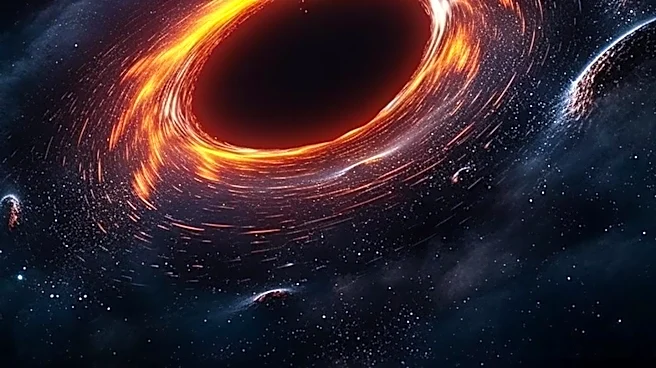
New simulations reveal that intermediate-mass black holes (IMBHs), which weigh between 100 and 100,000 times the mass of the Sun, can cause a unique type of supernova by tidally disrupting white dwarfs. These IMBHs are difficult to detect directly but
are thought to reside in the dense cores of some star clusters. When a white dwarf, a dense stellar remnant, strays too close to an IMBH, it can be torn apart. This disruption can lead to a thermonuclear supernova, an explosion that resembles those from double-white-dwarf mergers but exhibits a strong dependence on the viewing angle for its brightness and spectra. The study, led by CITA Postdoctoral Fellow Pavan Vynatheya, used high-resolution hydrodynamic simulations and radiative-transfer modeling to predict how these events would appear from Earth.
Why It's Important?
The discovery that intermediate-mass black holes can trigger lopsided supernovae by shredding white dwarfs is significant because it offers a promising method for detecting these elusive IMBHs, which are considered the 'missing link' between stellar-mass and supermassive black holes. White dwarfs are too dense to be torn apart by supermassive black holes without disappearing without a trace, making their disruption by an IMBH a unique signature. Catching such an event would provide strong, direct evidence for the presence of an IMBH. With next-generation surveys like the Vera C. Rubin Observatory expected to discover many more tidal disruption events, the distinctive light curves, spectra, and viewing-angle dependence identified in this study will help astronomers differentiate these rare white dwarf disruptions from other transient phenomena, thereby aiding in locating where IMBHs are hiding.
What's Next?
The findings from this study will guide future astronomical observations, particularly with upcoming surveys like the Vera C. Rubin Observatory, to identify the unique signatures of white dwarf disruptions by intermediate-mass black holes. Astronomers will be looking for supernovae with specific light curves, spectra, and viewing-angle dependencies that match the predictions of these simulations. Further theoretical work will likely involve refining the models to account for more complex astrophysical conditions and to better predict the observable characteristics of these events. The ultimate goal is to confirm the existence and distribution of intermediate-mass black holes, which will fill a crucial gap in our understanding of black hole evolution and the dynamics of star clusters.
Beyond the Headlines
The potential to detect intermediate-mass black holes through their interaction with white dwarfs opens a new window into the extreme physics of the universe. These IMBHs represent a critical piece of the cosmic puzzle, bridging the gap between the smaller black holes formed from individual stars and the colossal supermassive black holes at galactic centers. Understanding their formation and behavior could shed light on how supermassive black holes grow and how galaxies evolve. This research also highlights the power of computational astrophysics, where complex simulations can predict observable phenomena, guiding empirical observations and pushing the boundaries of our knowledge about the most mysterious objects in the cosmos. It underscores the intricate and often violent processes that shape the universe.