





What's Happening?
The U.S. Air Force is actively seeking to enhance its maritime strike capabilities by developing a new air-launched cruise missile that can be deployed from transport aircraft. This initiative, known as the Family of Affordable Mass Missiles – Beyond
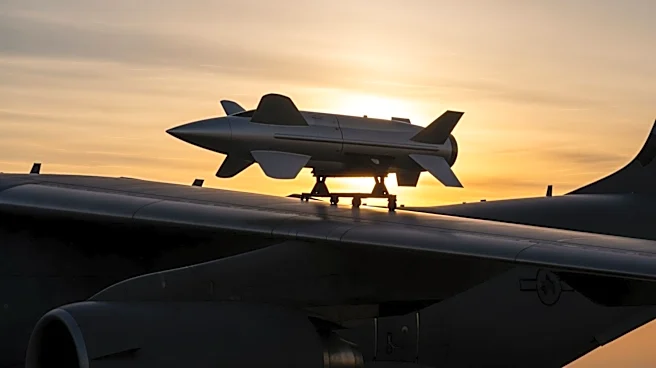
Adversary’s Reach (FAMM-BAR), aims to create a missile system that can be launched from cargo pallets in flight. The Air Force has issued a formal request for information to industry players, seeking solutions for a munition capable of being produced at a rate of up to 2,000 units annually. The envisioned system would allow transport aircraft to air-launch long-range cruise missiles from their cargo holds, targeting slow-moving maritime vessels. This development builds on existing capabilities provided by the U.S. Navy’s Long Range Anti-Ship Missile (LRASM), a derivative of the Joint Air-to-Surface Standoff Missile (JASSM).
Why It's Important?
This initiative is significant as it represents a strategic enhancement of the U.S. military's maritime strike capabilities, potentially increasing the flexibility and reach of its air power. By enabling transport aircraft to launch long-range missiles, the Air Force could effectively expand its operational range and strike capabilities without relying solely on traditional fighter jets or bombers. This could provide a tactical advantage in maritime conflicts, allowing for rapid deployment and engagement of targets at sea. The ability to produce these missiles at a high rate also suggests a focus on maintaining a robust and sustainable arsenal, which is crucial for long-term military readiness and deterrence.
What's Next?
The Air Force's request for information indicates a move towards formalizing the development and production of this new missile system. Industry responses will likely shape the next steps, including potential contracts and further testing. The Air Force has already conducted initial tests with a related system, the FAMM-Lugged, using the F-16 strike fighter. As the program progresses, further testing and validation will be necessary to ensure the system meets operational requirements. The development of this capability could prompt reactions from other military powers, potentially influencing global military strategies and alliances.