
What's Happening?
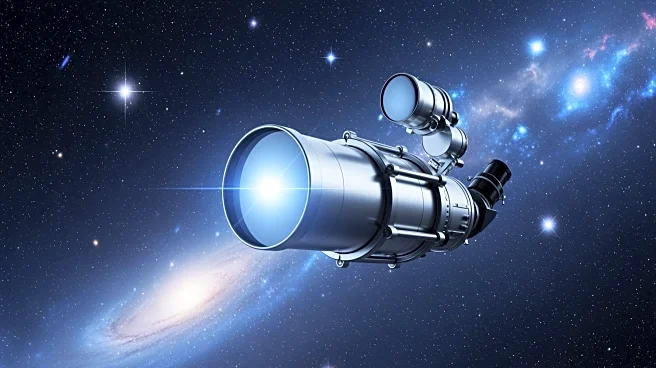
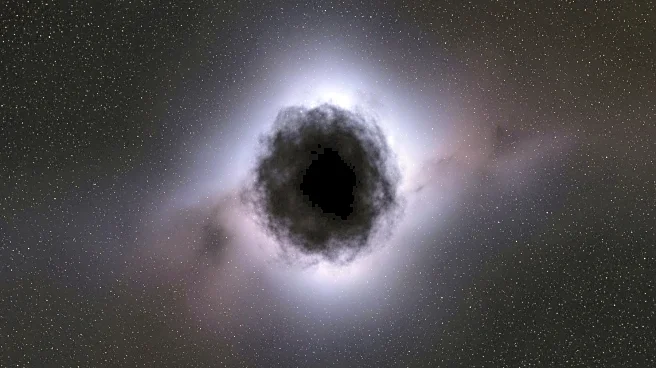
NASA, using the Hubble Space Telescope, has discovered a starless, gas-rich dark matter cloud named 'Cloud-9'. This object is considered a relic from early galaxy formation and marks the first confirmed
detection of such an object in the universe. The discovery was initially made through a radio survey by the Five-hundred-meter Aperture Spherical Telescope in China and later confirmed by facilities in the United States. The Hubble Telescope's advanced capabilities allowed researchers to confirm that Cloud-9 contains no stars, providing a unique insight into the dark universe and the nature of dark matter.
Why It's Important?
The discovery of Cloud-9 is significant for understanding the composition and formation of the universe. It offers a rare glimpse into a dark-matter-dominated cloud, which could help scientists learn more about the early universe and the role of dark matter in galaxy formation. This finding supports theoretical models that suggest most of the universe's mass is dark matter, which is challenging to detect due to its lack of light emission. The research could lead to further discoveries of similar objects, enhancing our knowledge of cosmic evolution and the fundamental forces shaping the universe.
What's Next?
Following this discovery, scientists may focus on identifying more starless dark matter clouds to better understand their distribution and characteristics. Further observations using advanced telescopes could provide additional data on the properties of dark matter and its influence on galaxy formation. This research may also inspire new theoretical models and simulations to predict the behavior of dark matter in the universe. Collaborative efforts between international space agencies and research institutions will likely continue to explore these cosmic phenomena.