




What's Happening?
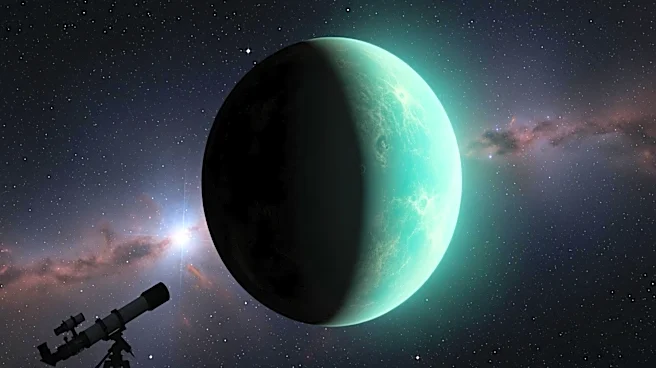
Astronomers have been puzzled for centuries by a faint glow observed on the dark side of Venus, known as 'ashen light.' This phenomenon was first noted by Italian astronomer Giovanni Battista Riccioli in 1643. Despite numerous theories over the years,
including solar ultraviolet light, aurorae, and lightning, the exact cause remains elusive. Recent data from NASA's Parker Solar Probe suggests that the glow might be due to 'nightglow,' where the upper atmosphere of Venus lights up after a coronal mass ejection from the sun. This emission, primarily at 557.7 nm, is similar to the green tint seen in some of Earth's auroras. However, the glow is difficult to detect with the naked eye, leading to speculation that those who claim to have seen it may have unusually red-sensitive vision or are experiencing an optical illusion.
Why It's Important?
Understanding the ashen light on Venus is crucial for astronomers as it could provide insights into the planet's atmospheric conditions and its interaction with solar activity. This knowledge is significant for comparative planetology, helping scientists draw parallels between Venus and Earth, particularly in understanding atmospheric phenomena. The study of Venus's atmosphere can also inform future missions and the search for life on other planets by highlighting how different planetary environments respond to solar influences. Additionally, unraveling this mystery could enhance our understanding of atmospheric physics and contribute to the broader field of space science.
What's Next?
Future observations and missions to Venus, such as those planned by NASA and other space agencies, may provide more data to solve the mystery of the ashen light. Continued monitoring by orbiters like Japan's Akatsuki, equipped with specialized cameras, could capture more evidence of the phenomenon. As technology advances, new instruments may be developed to detect the faint glow more accurately, potentially confirming or refuting existing theories. Collaboration between international space agencies could also accelerate the discovery process, pooling resources and expertise to unlock the secrets of Venus's atmosphere.