





What's Happening?
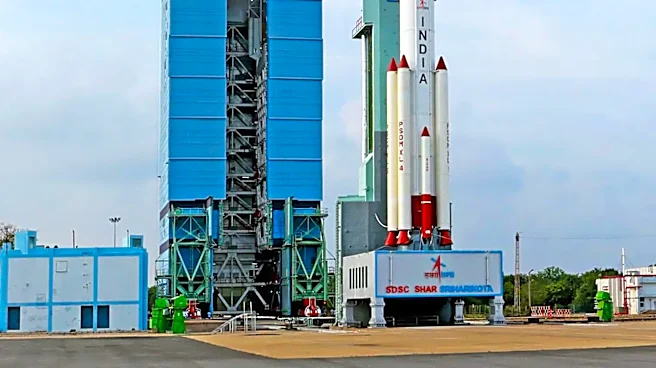
India successfully launched the NVS-03 navigation satellite aboard a GSLV-F18 rocket from the Satish Dhawan Space Centre on October 30, 2026. This launch is crucial for restoring India’s independent regional navigation satellite system, NavIC (Navigation
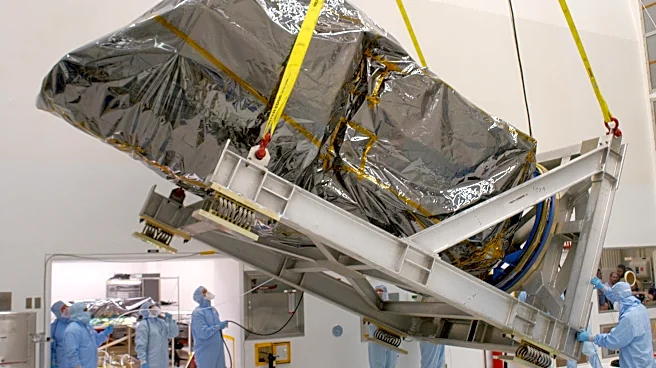
with Indian Constellation), to its minimum operational configuration of four satellites. The 2,250 kg satellite is the third in ISRO's next-generation navigation satellite series, designed to ensure the continuity and modernization of navigation services under the Indian Regional Navigation Satellite System (IRNSS). The NVS-03 carries an indigenously developed Rubidium atomic clock, a significant step towards self-reliance in high-precision space timing, as older satellites relied on imported clocks that experienced failures. Additionally, the satellite transmits on the L1 frequency band, which is commonly used in commercial GPS receivers, aiming to make NavIC signals more accessible to everyday mobile chipsets.
Why It's Important?
The successful launch of NVS-03 is vital for India's strategic autonomy and technological independence. By restoring NavIC to a four-satellite operational status, India ensures its ability to provide accurate positioning, navigation, and timing (PNT) services across its landmass and up to 1,500 kilometers beyond its borders. This system offers both an open signal for public use in navigation, mapping, and logistics, and an encrypted restricted service for military applications, which is critical for guiding missiles, tracking troop movements, and operating defense platforms securely. The development of indigenous atomic clocks reduces reliance on foreign technology, enhancing national security and technological sovereignty. The integration of the L1 frequency band will broaden the accessibility of NavIC for civilian applications, potentially impacting various sectors from transportation to fishing, as highlighted by ISRO chief V. Narayanan, who noted that 10,400 locomotives and 64,000 fishing vessels are currently tracked in real-time using NavIC.
What's Next?
The NVS-03 launch marks a significant step towards completing the full seven-satellite constellation required for NavIC to be fully integrated with mobile systems for wider public use. ISRO aims to expand the tracking of fishing vessels to 1 lakh within the next six months under the Pradhan Mantri Matsya Sampada Yojana. The continued development and deployment of additional satellites will further enhance the precision and reliability of NavIC services. The focus will also be on the performance of the indigenous Rubidium atomic clocks, with two already functioning in orbit and the third now placed in space. Once the full constellation is operational, it is expected that NavIC will become more widely available on civilian mobile phones, further solidifying India's independent navigation capabilities and reducing its dependence on foreign systems like GPS.
Beyond the Headlines
The NVS-03 launch underscores India's long-term commitment to self-reliance in critical space technologies, a goal that gained momentum after the 1999 Kargil War when access to GPS was restricted by the U.S. This strategic imperative has driven India to develop its own robust navigation system, ensuring that its positioning and timing capabilities remain secure during geopolitical conflicts. The move towards indigenous atomic clocks not only addresses past vulnerabilities but also positions India as a leader in advanced space technology. The dual-use nature of NavIC, serving both civilian and defense needs, highlights its profound impact on national security, economic development, and public services. The broader adoption of NavIC in commercial applications, facilitated by the L1 band integration, could foster innovation in various industries and enhance the daily lives of Indian citizens by providing more accurate and reliable navigation services.