



What's Happening?
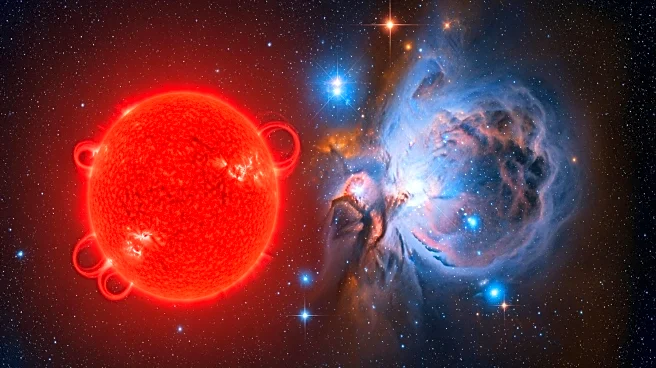
NASA is examining the star Betelgeuse and the Crab Nebula to understand the processes of stellar death and rebirth. Betelgeuse, a supergiant star in the Orion constellation, has been observed dimming, leading to speculation about a potential supernova.
However, it is believed that Betelgeuse may not explode imminently. The Crab Nebula, located in the Taurus constellation, is the remnant of a supernova that occurred in 1054. It provides a glimpse into the aftermath of such stellar explosions. The nebula's expanding gas clouds enrich the universe with heavy elements, essential for the formation of rocky planets like Earth. These observations are part of NASA's ongoing efforts to study stellar evolution and the life cycle of stars.
Why It's Important?
Understanding the life cycle of stars, including their death and rebirth, is crucial for comprehending the formation of elements and the evolution of galaxies. The study of Betelgeuse and the Crab Nebula offers insights into the processes that lead to supernovae and the subsequent distribution of elements necessary for planet formation. This research has implications for astrophysics and cosmology, as it helps scientists predict the behavior of other stars and the potential for similar events in our galaxy. The findings could also inform future space exploration missions and the search for habitable planets.