




What's Happening?
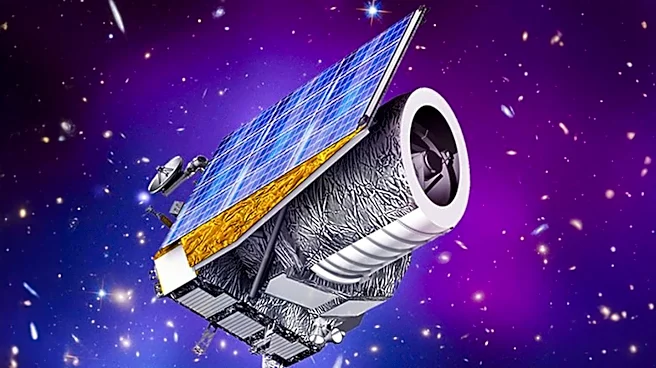
The European Space Agency's Euclid space telescope has identified 31 exceptionally ancient quasars, including two that are the earliest ever observed. These quasars were shining with the light equivalent to a trillion Suns when the universe was only 670
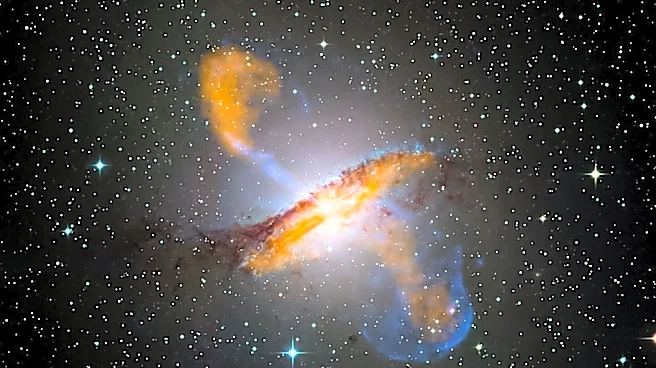
million years old, approximately 5% of its current age. The most ancient, EUCL J172902.75+641018.1, has a redshift of 7.77, and EUCL J125308.55+705432.3 has a redshift of 7.69. These objects are located over 13 billion light-years from Earth. According to Daming Yang of Leiden University, lead author of the Euclid discovery paper, these findings significantly increase the number of known ancient quasars and provide crucial insights into how supermassive black holes and galaxies formed and grew so rapidly in the early universe.
Why It's Important?
This discovery is critical for understanding the 'cosmic dawn,' the period when the first galaxies and supermassive black holes emerged. Quasars are vital 'time machines' that allow astronomers to observe the universe in its infancy. Euclid's ability to detect fainter and more numerous ancient quasars, beyond just the brightest ones, offers a more representative view of the early quasar population. This expanded dataset will help scientists address one of astrophysics' most enduring questions: how supermassive black holes became so enormous in such a remarkably short time after the Big Bang. The observations also shed light on the epoch of reionization, a transformative period when the universe transitioned from a cold, dark state to the ionized state observed today, establishing conditions for the universe's current structure.
What's Next?
As the Euclid space telescope continues its mission to map the cosmos, astronomers anticipate a growing collection of distant quasars. This ongoing data accumulation will provide further clues about the rapid growth of supermassive black holes and the evolution of early galaxies. Detailed investigations of these newly discovered quasars, such as the study of EUCL J125308.55+705432.3, which sits within a galaxy actively forming new stars, will continue. These studies aim to clarify the environmental conditions surrounding early supermassive black holes and their co-evolution with massive galaxies. The increased efficiency of Euclid in identifying these rare objects will accelerate research into the early universe, potentially leading to new models and theories.
Beyond the Headlines
The ability of Euclid to peer so far back in time and uncover these ancient cosmic beacons represents a significant leap in observational cosmology. This technological advancement not only provides empirical data to test theoretical models of the early universe but also highlights the profound interconnectedness of cosmic phenomena, from the formation of the first stars to the growth of supermassive black holes and the reionization of the universe. The findings underscore the dynamic and complex nature of cosmic evolution, challenging previous assumptions about the timeline and mechanisms of structure formation. This continuous unveiling of the universe's past deepens humanity's understanding of its own origins within the vast cosmic tapestry.