








What's Happening?
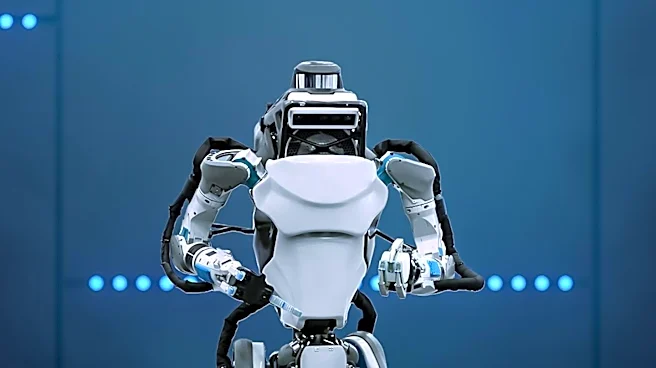
The second World Humanoid Robot Games in Beijing highlighted significant advancements in humanoid robotics, with industry insiders noting improved performance due to progress in core components and maturing supply chains. A key trend observed is the increasing
similarity and falling costs of hardware components used in these robots. This convergence in hardware is shifting the competitive landscape, making the underlying embodied AI foundation models, which act as the robots' 'brains,' the primary battleground for developers. The cost of manufacturing a humanoid robot capable of running has dramatically decreased from millions of yuan to approximately CNY100,000 (USD14,000), a trend expected to continue. This reduction in cost and standardization of components are attracting new entrants, including autonomous-driving companies and internet giants, into the humanoid robotics sector. The focus is now on developing sophisticated AI models, such as Vision-language-action (VLA) models for specialized tasks and world models for more open-ended environments, to enable practical and broadly applicable robot products.
Why It's Important?
The falling costs and converging hardware in humanoid robotics have significant implications for various U.S. industries and the global economy. As humanoid robots become more affordable and capable, their potential for widespread adoption in manufacturing, logistics, healthcare, and even domestic settings increases. This could lead to enhanced productivity, automation of labor-intensive tasks, and the creation of new service industries. U.S. companies in robotics, AI development, and related sectors stand to gain from these advancements, potentially fostering innovation and economic growth. However, it also raises questions about workforce displacement and the need for retraining programs to adapt to an increasingly automated economy. The shift in competition towards AI models means that U.S. leadership in AI research and development will be crucial for maintaining a competitive edge in the global robotics market. Furthermore, the entry of autonomous-driving and internet companies into this space signifies a broader integration of AI technologies across different sectors, potentially accelerating the development of general-purpose AI.
What's Next?
The continued decline in humanoid robot costs and the maturation of their supply chains are expected to drive further investment and innovation in the sector. Developers will likely intensify their efforts in refining embodied AI foundation models, focusing on improving generalization capabilities for diverse real-world applications. The competition between Vision-language-action (VLA) models and world models will shape the future development of robot intelligence, with VLA models targeting specialized work skills and world models aiming for more complex, open-ended environments like commercial and household settings. We can anticipate more companies, including U.S.-based tech giants and startups, entering the humanoid robotics space, leveraging their expertise in AI and autonomous systems. This will likely lead to a rapid evolution of robot capabilities, potentially resulting in the deployment of more practical and broadly applicable humanoid robots in various industries and daily life within the next few years. Regulatory frameworks and ethical considerations surrounding robot autonomy and human-robot interaction will also become increasingly important.
Beyond the Headlines
The rapid advancements in humanoid robotics, driven by falling costs and sophisticated AI models, extend beyond mere technological progress. Ethically, the increasing capability of robots to perform complex tasks raises questions about the nature of work, human dignity, and the potential for societal disruption. The development of more generalized AI models for robots could lead to machines that learn and adapt in ways previously confined to science fiction, prompting deeper philosophical discussions about consciousness and artificial intelligence. Legally, the deployment of autonomous humanoid robots in public and private spaces will necessitate new regulations concerning liability, safety, and data privacy. Culturally, the integration of humanoid robots into daily life could reshape social interactions, expectations of service, and even our understanding of what it means to be human. The long-term shift could see a redefinition of human roles in society, with a greater emphasis on creative and interpersonal skills that robots cannot easily replicate, while also posing challenges for equitable access to these advanced technologies and their benefits.