



What's Happening?
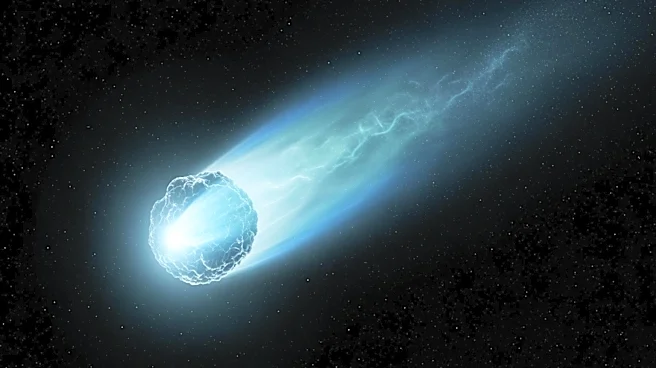
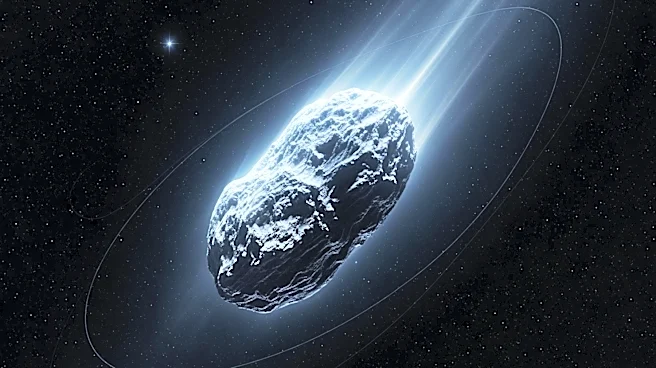
On July 1, 2025, the ATLAS survey in Chile identified a faint object, later confirmed as 3I/ATLAS, moving on a path not belonging to the solar system. This marks it as only the third known interstellar object to pass through our system, following 1I/‘Oumuamua
in 2017 and 2I/Borisov in 2019. The object, a comet, has already made its single pass through the inner solar system and is now heading back to interstellar space. The James Webb Space Telescope observed that the comet's coma is unusually rich in carbon dioxide, with a ratio significantly higher than typical comets. This suggests that 3I/ATLAS may have formed in a different environment, possibly exposed to more radiation than comets in our solar system. The isotopic analysis indicates that the object could be between 3 and 11 billion years old, potentially predating the Sun.
Why It's Important?
The discovery of 3I/ATLAS is significant as it provides a rare opportunity to study an object from another planetary system. Its unique composition and age offer insights into the conditions and processes that existed in the early universe, potentially before the formation of the Sun. Understanding such interstellar objects can enhance our knowledge of the materials and conditions that contribute to planetary formation. The presence of high carbon dioxide levels and other isotopic characteristics in 3I/ATLAS could inform theories about the chemical evolution of galaxies and the distribution of elements across the universe. This discovery also underscores the capabilities of modern astronomical tools like the James Webb Space Telescope in advancing our understanding of cosmic phenomena.
What's Next?
As 3I/ATLAS continues its journey out of the solar system, the focus will shift to analyzing the data collected during its brief visit. Scientists will refine their understanding of its composition, isotopic ratios, and age estimates using observations from Webb, Hubble, and other telescopes. The Vera C. Rubin Observatory, expected to become operational soon, may increase the frequency of detecting such interstellar visitors, allowing for comparative studies rather than treating each as a singular event. This could lead to a broader understanding of interstellar objects and their role in the cosmic landscape.