





What's Happening?
President Bola Tinubu has approved the establishment of the University of Public Relations and Leadership, a specialized institution aimed at advancing education, research, professional development, and leadership training in public relations and strategic
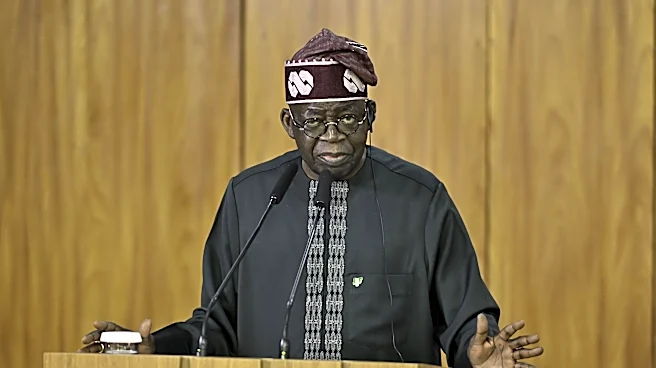
communication. The approval was announced by Vice President Kashim Shettima on behalf of President Tinubu at the 2026 World Public Relations Forum (WPRF) in Abuja. President Tinubu described the proposed university as a first-of-its-kind initiative globally and a lasting institutional legacy of Nigeria's hosting of the international public relations gathering. He emphasized that the institution would develop a new generation of communication leaders equipped to navigate a rapidly changing global environment. The President also urged public relations professionals to uphold high ethical standards in the face of misinformation and artificial intelligence.
Why It's Important?
The establishment of the University of Public Relations and Leadership signifies a strategic investment in the professionalization and advancement of communication disciplines. In an era marked by rapid information dissemination, misinformation, and the growing influence of artificial intelligence, skilled communication professionals are crucial for national development, democratic governance, and international cooperation. This institution aims to cultivate leaders who can promote truth, accountability, and mutual understanding, thereby strengthening the relationship between governments, institutions, and citizens. By fostering expertise in strategic communication, Nigeria seeks to enhance its global image, attract investment, and effectively counter negative narratives, ultimately contributing to economic growth and national stability.
What's Next?
Following President Tinubu's approval, the next steps will involve collaboration among the Nigerian Institute of Public Relations (NIPR), the Federal Ministry of Information and National Orientation, and the Nasarawa State Government to ensure the university's development into a center of excellence. Stakeholders are urged to work together to achieve national, continental, and international recognition for the institution. The university will likely begin developing its curriculum, recruiting faculty, and establishing its physical and operational infrastructure. Its future success will depend on sustained commitment from these entities and the broader professional community to ensure it meets its objectives of advancing public relations and leadership training.
Beyond the Headlines
The creation of this specialized university reflects a broader recognition of the critical role of strategic communication in modern governance and international relations. In a globalized world, a nation's narrative and its ability to communicate effectively are vital assets. This initiative could position Nigeria as a leader in public relations education on the African continent and beyond, attracting students and researchers from various countries. Furthermore, by emphasizing ethical communication and leadership, the university could contribute to fostering a more informed and engaged citizenry, which is essential for democratic health. It also underscores the government's intent to leverage communication as a tool for national branding and economic diplomacy, moving beyond traditional approaches to public information.