



What's Happening?
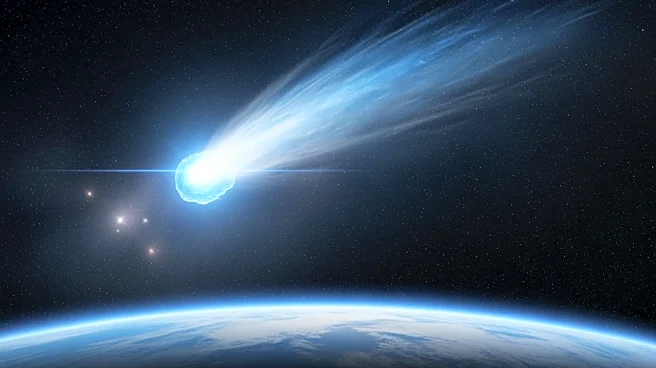
NASA is closely monitoring the interstellar comet 3I/ATLAS as it approaches its closest point to Earth on December 19, 2025. The comet, which originated from outside our solar system, is currently about 166.9 million miles from Earth. This event provides
a unique opportunity for astronomers to study a celestial body that formed around another star. The comet will not be visible to the naked eye, but it can be observed using telescopes. Recent observations have revealed a greenish glow in the comet's coma, attributed to diatomic carbon, and X-rays from interactions with the solar wind. NASA has confirmed that 3I/ATLAS poses no threat to Earth, as it will remain at a safe distance of about 1.8 astronomical units.
Why It's Important?
The flyby of 3I/ATLAS is significant because it is only the third confirmed interstellar object observed passing through our solar system. Studying such objects allows scientists to compare their characteristics with those of comets formed within our solar system, providing insights into the formation and evolution of planetary systems. The data collected during this flyby will enhance our understanding of cometary behavior and the dynamics of interstellar objects. This event also underscores the importance of international collaboration in space observation, as multiple space agencies and telescopes are involved in tracking and studying the comet.
What's Next?
Following its closest approach, 3I/ATLAS will continue its journey out of the solar system. NASA and other space agencies will keep observing the comet as it moves away, with plans to gather more data on its composition and behavior. The comet is expected to pass near Jupiter in March 2026, providing another opportunity for observation. The information collected during this period will contribute to ongoing research on interstellar objects and their impact on our understanding of the universe.
Beyond the Headlines
The study of 3I/ATLAS highlights the dynamic nature of our solar system and its interactions with interstellar space. The comet's journey offers a rare glimpse into the materials and processes that occur beyond our solar system, potentially revealing new information about the building blocks of planets and stars. This event also raises questions about the frequency and origins of interstellar visitors, prompting further research into the movement and characteristics of such objects.