
What's Happening?
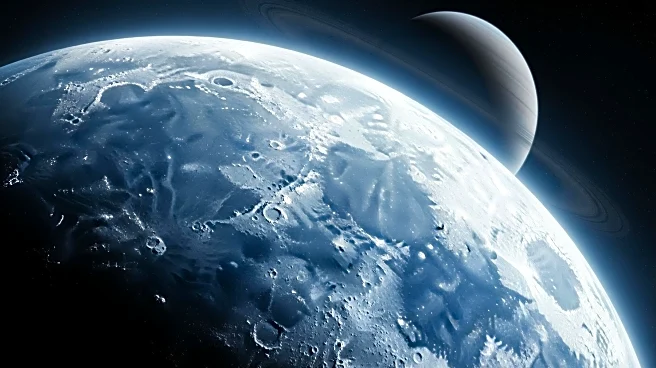
Recent reanalysis of data from NASA's Cassini-Huygens mission has led scientists to revise their understanding of Saturn's moon Titan. Initially believed to host a global subsurface ocean of liquid water,
Titan is now thought to have a large, slushy region beneath its ice crust. This conclusion is based on the detection of a 15-hour delay in Titan's deformation response to Saturn's gravitational pull, suggesting greater energy dissipation consistent with a more viscous, slush-like interior. The discovery of this slushy layer expands the range of potentially habitable environments, as pockets of freshwater within the slush could reach temperatures conducive to supporting simple organisms.
Why It's Important?
The revised understanding of Titan's interior has significant implications for the search for extraterrestrial life. The presence of a slushy layer rather than a liquid ocean suggests that the moon's environment might be more conducive to life than previously thought. Pockets of freshwater within the slush could concentrate nutrients, potentially supporting simple organisms. This finding prompts a reevaluation of interior models for other solar system moons and refines the parameters for the ongoing search for life beyond Earth. The study highlights the importance of understanding planetary interiors in the context of astrobiology.
What's Next?
The discovery of a slushy interior on Titan may lead researchers to reassess other moons in the solar system for similar conditions. Future missions could focus on exploring Titan's subsurface to better understand its potential for habitability. Scientists may also develop new models to predict the presence of slushy layers on other celestial bodies, guiding the search for life in the universe. The findings could influence the design of future space missions aimed at probing the interiors of icy moons.
Beyond the Headlines
The implications of Titan's slushy interior extend beyond astrobiology. Understanding the moon's geological processes could provide insights into the dynamics of icy bodies in the solar system. The study also raises questions about the energy dissipation mechanisms within planetary interiors, which could have broader applications in planetary science. Additionally, the findings may influence the development of technologies for exploring extreme environments, both on Earth and in space.