





What's Happening?
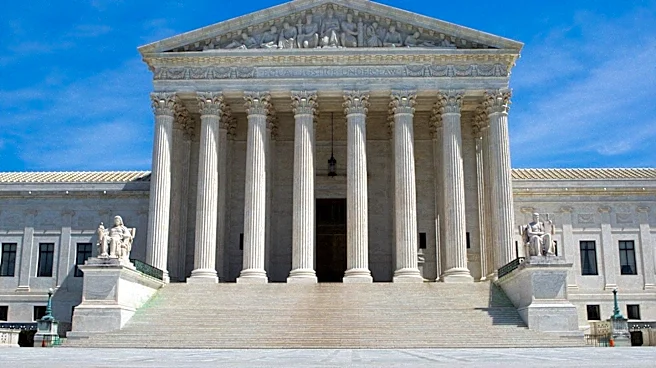
The U.S. Supreme Court appears likely to allow a lawsuit against Paramount Global to move forward, alleging that a website owned by the entertainment giant violated a 1988 video privacy law by sharing user information with Facebook. The case, Salazar
v. Paramount Global, centers on whether the Video Privacy Protection Act (VPPA) applies to modern internet streaming services. Michael Salazar, a Tennessee man, claims that Paramount Global's 247Sports.com website used a 'Pixel' to transmit his video-viewing history to Facebook without his consent. Lower courts had dismissed the case, ruling that Salazar was not a 'consumer' under the VPPA because the website's newsletter was not 'audio-visual content.' However, during oral arguments, justices expressed concerns about the broad implications of the law but seemed inclined to agree that the VPPA could apply to consumers of products from companies that provide videos, even if those videos are streamed online.
Why It's Important?
This case holds significant implications for digital privacy and the interpretation of decades-old laws in the context of modern technology. A ruling in favor of Salazar could open the door to numerous lawsuits against U.S. companies that stream videos and share user data, potentially forcing a re-evaluation of data-sharing practices across the internet. It highlights the challenge of applying pre-internet legislation to the complexities of online platforms and data analytics. The outcome could compel companies to seek explicit consent from users before sharing video-viewing information, thereby enhancing consumer privacy protections. Conversely, a broad interpretation of the VPPA could create substantial legal and financial burdens for businesses, particularly those in the entertainment and media sectors, necessitating significant changes to their data handling and privacy policies.
What's Next?
A decision in Salazar v. Paramount Global is expected sometime next year. The Supreme Court's ruling will clarify the applicability of the Video Privacy Protection Act to contemporary digital services. If the court allows the lawsuit to proceed, it will likely return to lower courts to address remaining questions, such as what constitutes a 'video tape service provider' in the digital age and whether the shared information qualifies as 'personally identifiable information.' Companies like Paramount Global may be prompted to implement more robust consent mechanisms for data sharing to mitigate future legal risks. The case could also spur legislative efforts to update privacy laws to better address the realities of internet-era data collection and usage, potentially leading to new regulations governing how online platforms handle user information.
Beyond the Headlines
The underlying issue in this case extends beyond legal definitions to the ethical considerations of user data privacy in an increasingly interconnected world. The VPPA was enacted in response to a specific incident involving the disclosure of a public figure's video rental history, underscoring the sensitivity of personal viewing habits. Today, with vast amounts of data collected and shared online, the potential for misuse or unwanted disclosure is far greater. This lawsuit brings to the forefront the tension between companies' desire to leverage data for targeted advertising and user experience, and individuals' right to privacy. The justices' discussion about companies easily avoiding lawsuits by obtaining consent or ceasing the practice of selling personal information highlights a growing societal expectation for greater transparency and control over personal data, potentially influencing broader industry standards and consumer expectations regarding digital privacy.