



What's Happening?
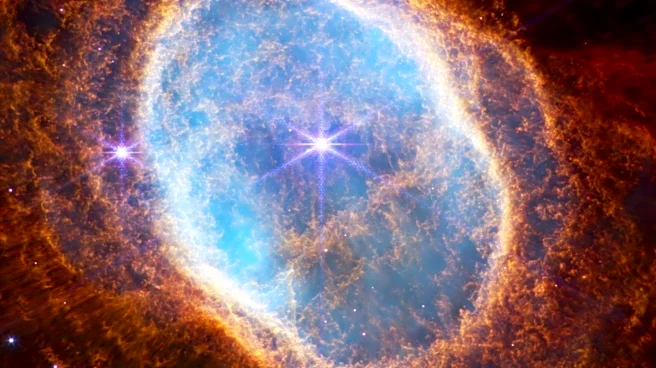
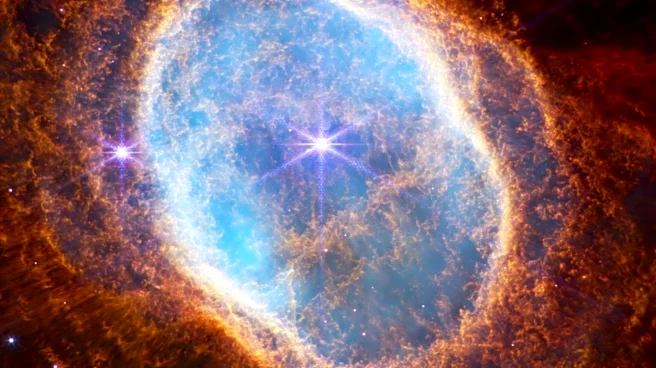
NASA's James Webb Space Telescope (JWST) has captured a detailed mid-infrared view of the Cat's Head Nebula, released on October 29, 2026. The nebula's distinctive shape is believed to have been sculpted by the intense ultraviolet radiation and winds
emanating from massive stars within the Carina Nebula. As this stellar feedback erodes surrounding gas and dust, denser material within the feline-shaped pillar has resisted erosion, maintaining its form. The image processing was conducted by Joseph DePasquale of STScI, highlighting the intricate structures within this cosmic formation. This observation provides new insights into the dynamic processes occurring in star-forming regions and how massive stars influence their environments.
Why It's Important?
The imaging of the Cat's Head Nebula by the James Webb Space Telescope is significant for astrophysics and space science. It offers an unprecedented level of detail, allowing scientists to study the complex interactions between massive stars and the interstellar medium. Understanding how stellar winds and radiation sculpt nebulae is crucial for comprehending star formation processes and the evolution of galaxies. The ability of JWST to capture mid-infrared views penetrates dust clouds, revealing hidden structures and providing data that can help refine models of stellar feedback. This contributes to a broader understanding of the universe's fundamental building blocks and the life cycles of stars.
What's Next?
Future observations with the James Webb Space Telescope are expected to continue exploring similar nebulae and star-forming regions with enhanced clarity. Scientists will likely use this new data to conduct further analyses, potentially leading to new discoveries about the physical and chemical conditions within these environments. The detailed imagery will enable researchers to track changes over time, if subsequent observations are made, offering dynamic insights into stellar evolution. This ongoing research will contribute to a more comprehensive understanding of how stars are born and how they shape their cosmic surroundings.
Beyond the Headlines
The stunning images from the James Webb Space Telescope, such as that of the Cat's Head Nebula, transcend scientific utility by inspiring public interest in space exploration and astronomy. These visuals serve as a powerful reminder of the vastness and beauty of the cosmos, fostering a sense of wonder and encouraging scientific literacy. Beyond the immediate scientific findings, such observations contribute to humanity's collective knowledge and our place in the universe. The advanced capabilities of JWST are pushing the boundaries of what is observable, potentially leading to paradigm shifts in astrophysical theories and our understanding of cosmic origins.