
What's Happening?
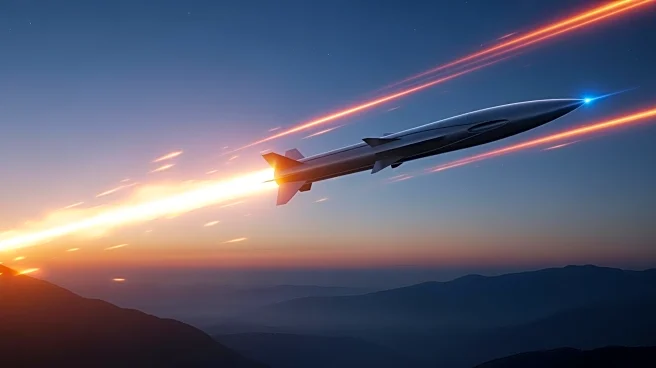
North Korea has announced the successful test of hypersonic missiles, observed by leader Kim Jong Un, as part of efforts to enhance the country's nuclear deterrent capabilities. The tests, reported by the Korean
Central News Agency, were conducted to assess the readiness and operational capabilities of the missile troops. This development comes as North Korea continues to showcase its military advancements ahead of a major political conference. The tests were detected by neighboring countries, which accused North Korea of provocations. The possession of hypersonic weapons could potentially allow North Korea to bypass U.S. and South Korean missile defenses. Recent weeks have seen North Korea testing various missile systems and making progress on a nuclear-powered submarine.
Why It's Important?
The advancement of North Korea's missile technology, particularly hypersonic weapons, poses a significant challenge to regional security and the strategic balance in East Asia. Hypersonic missiles, capable of traveling at speeds exceeding Mach 5, are difficult to intercept, raising concerns for the U.S. and its allies. The tests underscore North Korea's commitment to strengthening its military capabilities, potentially complicating diplomatic efforts to denuclearize the Korean Peninsula. The timing of these tests, coinciding with a U.S. military operation in Venezuela, suggests North Korea's intent to assert its sovereignty and deter perceived threats. The international community, particularly the U.S. and South Korea, may need to reassess their defense strategies and diplomatic approaches in response to these developments.
What's Next?
The upcoming Workers' Party congress in North Korea may provide further insights into Kim Jong Un's strategic intentions, including potential shifts in diplomatic relations with the U.S. and South Korea. The summit between South Korean President Lee Jae Myung and Chinese President Xi Jinping could also influence regional dynamics, as China plays a crucial role in mediating tensions on the Korean Peninsula. The international community will likely monitor North Korea's actions closely, with potential implications for future negotiations and security arrangements in the region.