









What's Happening?
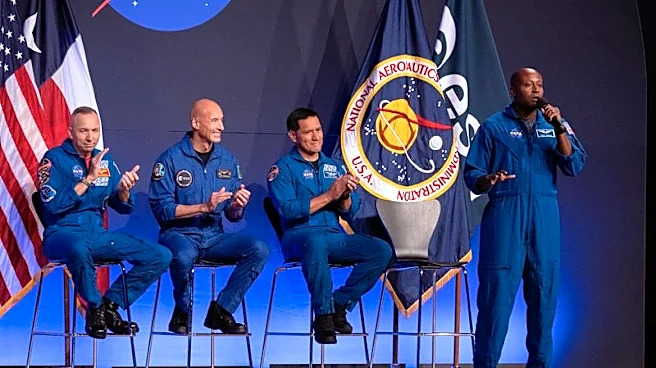
NASA's recent announcement of an all-male crew for the Artemis III mission has sparked criticism from various quarters. The crew, consisting of NASA's Randy Bresnik, ESA's Luca Parmitano, and NASA's Andre Douglas and Frank Rubio, was selected based on qualifications,
according to NASA officials. The decision has been defended by NASA Administrator Jared Isaacman, who emphasized that the selection process focused on the best candidates for the mission's objectives. Despite the backlash, NASA maintains that the selection was not intended to exclude any gender and highlights the diversity within the astronaut corps.
Why It's Important?
The controversy surrounding the all-male crew selection for Artemis III underscores ongoing discussions about diversity and representation in space exploration. While NASA has made strides in increasing diversity within its astronaut corps, the absence of women in this high-profile mission has raised questions about gender representation. The situation highlights the challenges NASA faces in balancing mission requirements with broader societal expectations for diversity. The outcome of this debate could influence future crew selections and NASA's approach to diversity and inclusion.
Beyond the Headlines
The selection process for NASA missions involves complex considerations, including the astronauts' availability, expertise, and mission-specific skills. While gender diversity is an important factor, the primary focus remains on selecting the best candidates to achieve mission objectives. The Artemis III mission, being a test-piloting mission, required astronauts with significant flying experience, which may have influenced the selection. The broader implications of this controversy may lead to increased scrutiny of NASA's selection processes and a reevaluation of how diversity is integrated into mission planning.