




What's Happening?
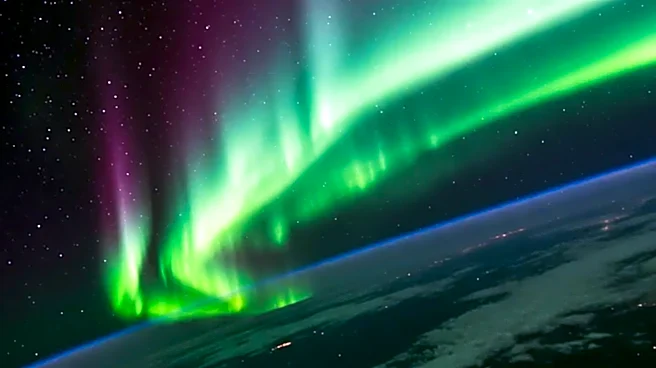
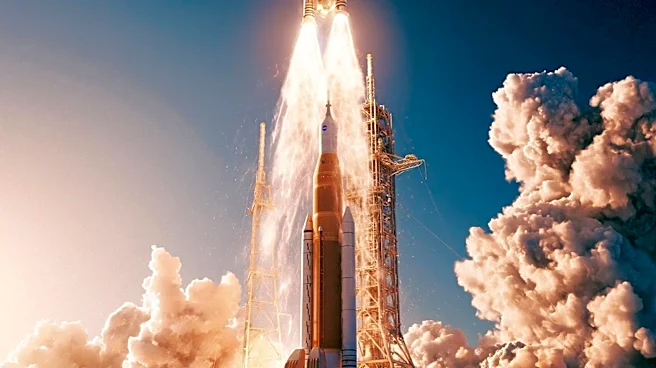
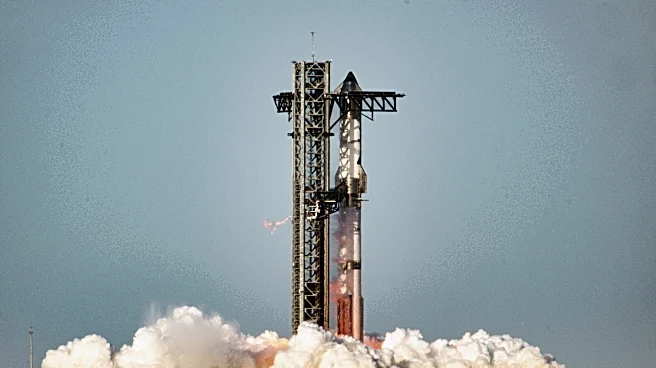
A recent study from Taiwan's National Cheng Kung University indicates that the Artemis II rocket launch on April 1 generated three ionospheric disturbances, each spanning approximately 5,000 kilometers across North America. These disturbances, described
as resembling giant contrails, were strong enough to potentially cause GPS positioning errors of several meters. Researchers utilized ground-based GPS receivers to track shifts in free-electron concentrations as the Space Launch System (SLS) rocket ascended. The study, published as a preprint in Geophysical Research Letters, found that two upper-stage burns, occurring over an hour after liftoff at an altitude of about 185 kilometers, were primarily responsible for the most significant effects. While the study identified potential GPS disruptions, no confirmed GPS failures, navigation disruptions, accidents, or other real-world effects have been reported in connection with the launch.
Why It's Important?
The findings from the Artemis II launch highlight a growing concern regarding the impact of powerful rocket launches on Earth's ionosphere, a critical layer for communication and navigation systems like GPS. While no actual GPS malfunctions were confirmed, the potential for several-meter positioning errors could have significant implications for technologies reliant on precise GPS data, such as autonomous vehicles and drones. Researcher Charles Lin emphasized that such an error scale could cause an autonomous car to change lanes. This research serves as a warning for future space missions, particularly as NASA aims for a sustained human presence on the Moon, which will involve more frequent heavy rocket launches. The increased frequency of these launches could lead to more problematic ionospheric disturbances, affecting various sectors that depend on accurate satellite navigation.
What's Next?
As space agencies like NASA continue to pursue ambitious lunar and Martian missions, the frequency of powerful rocket launches is expected to increase. This trend suggests that ionospheric disturbances could become a more significant issue, potentially leading to more frequent or intense GPS disruptions. Scientists will likely continue to monitor and study these space weather effects to better understand and mitigate their impact. The research from the Artemis II launch underscores the need for ongoing investigation into how large rockets interact with Earth's upper atmosphere. Future developments may include enhanced GPS systems designed to be more resilient to such disturbances or new protocols for launch trajectories to minimize atmospheric impact, especially as autonomous technologies become more prevalent and reliant on precise positioning.
Beyond the Headlines
The study's findings extend beyond immediate GPS concerns, touching upon the broader environmental and technological implications of increased space activity. The ionosphere, a natural shield that reflects and modifies radio waves, is being demonstrably affected by human-made rocket launches. This raises questions about the long-term effects of frequent space travel on Earth's atmospheric layers and the potential for cumulative impacts on global communication and navigation infrastructure. The comparison to a SpaceX Falcon 9 launch, which produced a much smaller effect, highlights the scale of the Artemis II disturbance and suggests that larger rockets may have disproportionately greater atmospheric impacts. This could lead to a re-evaluation of launch technologies and environmental regulations for space missions, balancing scientific exploration and commercial space endeavors with the preservation of critical atmospheric conditions.