


What's Happening?
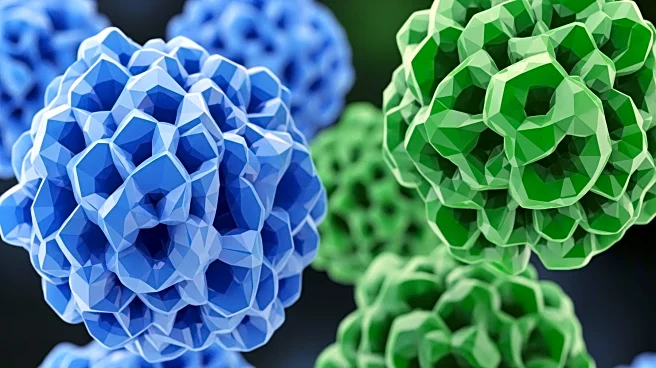
A study published in Nature Chemical Biology reveals that peroxiredoxins, a family of antioxidant enzymes, can assemble into more diverse structures than previously thought. Traditionally believed to form uniform decamers, these enzymes can actually create
heterooligomers, mixing different protein isoforms. This discovery was made by researchers from VIB, Vrije Universiteit Brussel, Saarland University, and RPTU University Kaiserslautern-Landau. The ability to form mixed complexes allows cells to fine-tune redox signaling and stress responses, enhancing structural and functional diversity. This mechanism is conserved across various species, including humans, yeast, and plants.
Why It's Important?
The findings challenge long-held assumptions about the structural assembly of peroxiredoxins, offering new insights into cellular adaptability and redox regulation. By understanding how these enzymes form diverse complexes, scientists can better comprehend how cells manage oxidative stress and maintain homeostasis. This research could have implications for diseases where redox balance is disrupted, such as cancer and metabolic disorders. The study also highlights the evolutionary advantage of molecular diversity, suggesting that cells can achieve complexity and adaptability with a limited set of protein modules.
What's Next?
Future research will likely focus on understanding the physiological conditions under which different peroxiredoxin assemblies dominate. Scientists aim to explore how cells regulate the formation of these complexes and their role in disease processes. The study opens new avenues for investigating the molecular mechanisms underlying redox signaling and stress responses. Additionally, researchers may explore potential therapeutic applications, targeting these enzymes to modulate redox balance in disease contexts.