





What's Happening?
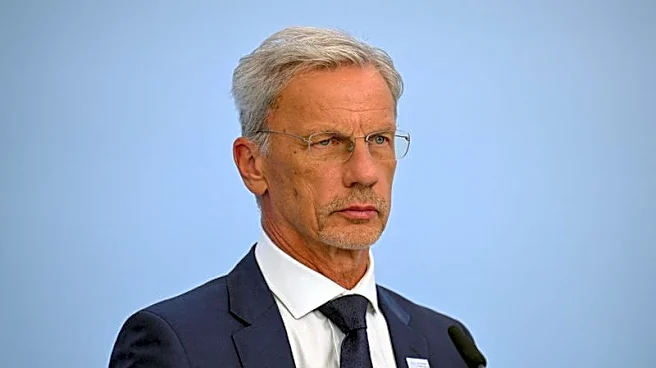
Valdis Dombrovskis, the European Commission Executive Vice-President for Economy and Productivity, is spearheading efforts to enhance policy coordination among EU member states to achieve common economic goals. His responsibilities include ensuring consistent
implementation of fiscal rules under the Stability and Growth Pact and overseeing the continued rollout of NextGenerationEU and the Recovery and Resilience Facility. Dombrovskis is also tasked with developing a new tool to translate EU competitiveness objectives into coordinated national policies and strengthening the European Investment Fund to boost financing for European companies. Furthermore, he is working on the development of a digital euro and aims to reinforce the international role of the euro. In his role as Commissioner for Implementation and Simplification, Dombrovskis is focused on reducing administrative and reporting burdens for individuals and businesses. This involves reviewing EU law to eliminate overlaps and contradictions, implementing new consultation approaches to identify stakeholder challenges in applying EU rules, and negotiating a renewed agreement between EU institutions to streamline existing legislation and improve the creation of new laws. He also supports other Commissioners in preparing their annual progress reports on enforcement and implementation.
Why It's Important?
These initiatives by Executive Vice-President Dombrovskis are crucial for the economic stability and competitiveness of the European Union, which has significant implications for global trade and U.S. economic interests. Consistent fiscal policy implementation and the effective deployment of recovery funds can foster a more robust European economy, potentially increasing demand for U.S. exports and investment. The development of a digital euro and the strengthening of the euro's international role could influence global financial markets and potentially impact the U.S. dollar's dominance, requiring U.S. businesses and financial institutions to adapt. Efforts to simplify EU regulations could reduce barriers for U.S. companies operating within the EU, making it easier and more cost-effective to conduct business. Conversely, a more competitive EU economy could also intensify competition for U.S. industries in global markets. The success of these policies will shape the EU's economic trajectory, affecting trade relations, investment flows, and overall economic partnership with the United States.
What's Next?
Executive Vice-President Dombrovskis will continue to lead negotiations and implement policies aimed at economic coordination and regulatory simplification within the EU. This includes ongoing efforts to ensure member states adhere to fiscal rules and the continued disbursement and effective utilization of NextGenerationEU funds. The development of a digital euro will progress, with further details and potential implementation timelines expected to emerge. Stakeholders, including U.S. businesses with operations in Europe, should monitor the evolution of EU regulations and economic policies, particularly those related to competitiveness and administrative burden reduction. The outcomes of these initiatives will likely influence future trade agreements and economic dialogues between the U.S. and the EU. Regular reports on enforcement and implementation will provide insights into the effectiveness of these measures and potential adjustments.
Beyond the Headlines
Beyond the immediate economic and regulatory impacts, Dombrovskis's work touches upon deeper themes of European integration and global economic influence. The push for greater policy coordination among member states reflects a broader ambition to strengthen the EU's internal cohesion and its capacity to act as a unified economic bloc on the world stage. The focus on a digital euro and the international role of the euro signifies a strategic move to enhance the EU's financial sovereignty and reduce reliance on other currencies, which could have long-term geopolitical implications. The emphasis on reducing administrative burdens also highlights an ongoing challenge for large, multi-national entities to balance regulatory oversight with economic efficiency. These efforts are not just about economic growth but also about shaping the EU's identity and power in a rapidly evolving global landscape, potentially leading to shifts in international economic alliances and trade dynamics that the U.S. will need to navigate.