
What's Happening?
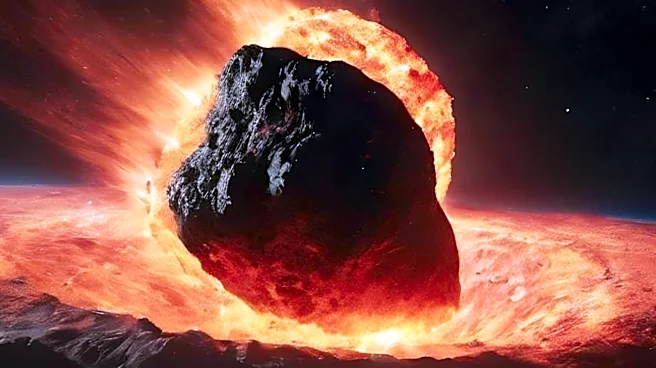
A recent study published in AGU Advances explores the possibility that early asteroid impacts on Earth could have created environments conducive to the emergence of life. The research suggests that these impacts may have cracked the Earth's crust, allowing
hot water systems to form, which could facilitate chemical reactions necessary for life. The study estimates that such impacts could have made much of the Earth's upper crust open to water around 4.3 billion years ago. However, the study acknowledges that while these conditions might allow for chemical reactions, they do not explain the complex systems required for life, such as DNA, RNA, and proteins.
Why It's Important?
The study provides a potential explanation for how life could have originated on Earth, contributing to the ongoing debate about the origins of life. By suggesting that asteroid impacts created environments where life could potentially evolve, the research adds a new dimension to our understanding of early Earth conditions. This could have implications for the search for life on other planets, as similar impact events may have occurred elsewhere in the solar system. Understanding the conditions that could lead to the emergence of life is crucial for astrobiology and the study of planetary habitability.
What's Next?
Further research is needed to explore the potential for life to arise in hot water systems created by asteroid impacts. Scientists may conduct experiments to simulate these conditions and investigate the types of chemical reactions that could occur. Additionally, the study may prompt a reevaluation of the role of asteroid impacts in shaping the Earth's geological and biological history. This research could also inform future missions to other planets, where scientists will look for similar impact-related environments that might harbor life.