





What's Happening?
NASA has successfully completed the construction of the Nancy Grace Roman Space Telescope, a significant achievement as it was finished ahead of schedule and under budget. Named after NASA's first chief astronomer, the telescope is set to launch in September
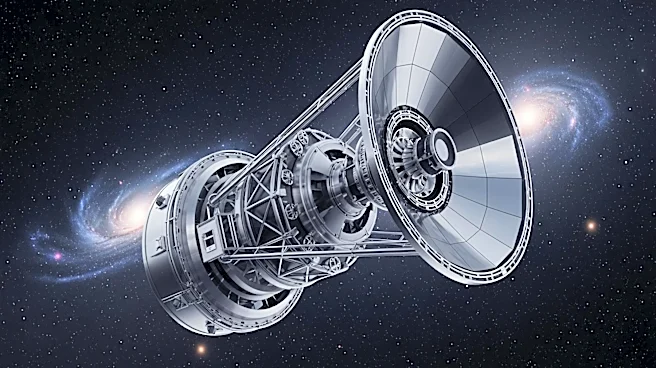
aboard a SpaceX Falcon Heavy, earlier than the initially planned May 2027 launch. The Roman Telescope features a primary mirror that is 7.9 feet across, similar in size to the Hubble's but significantly lighter. It is equipped with two sensors: the Wide Field Instrument, a 300-megapixel camera, and the Roman Coronagraph, which reduces light from distant stars to reveal orbiting planets. This telescope is designed to explore the universe by scanning the sky in high detail, potentially discovering new galaxies and phenomena.
Why It's Important?
The completion of the Nancy Grace Roman Space Telescope marks a pivotal moment for NASA and the field of astronomy. By being ahead of schedule and under budget, it sets a new standard for efficiency in space projects. The telescope's capabilities will allow scientists to explore the universe in unprecedented detail, potentially discovering billions of new galaxies and stars. This could lead to significant advancements in our understanding of the cosmos and the identification of new celestial phenomena. The Roman Telescope complements the James Webb Space Telescope by focusing on exploration rather than high-resolution imaging of known objects, thus broadening the scope of astronomical research.
What's Next?
With the telescope's construction complete, the next step is its launch in September. Once operational, the Roman Telescope will begin its mission to scan the sky, providing data that could lead to groundbreaking discoveries in astronomy. The scientific community eagerly anticipates the insights it will offer, which could reshape our understanding of the universe. The successful deployment and operation of the telescope will also serve as a model for future space missions, emphasizing the importance of innovation and efficiency in space exploration.