

What's Happening?
President Trump and Vice President JD Vance have presented conflicting statements regarding the primary objective of the U.S. war with Iran, nearly six months into the conflict. Vice President Vance stated in a Fox News interview that 'goal number one'
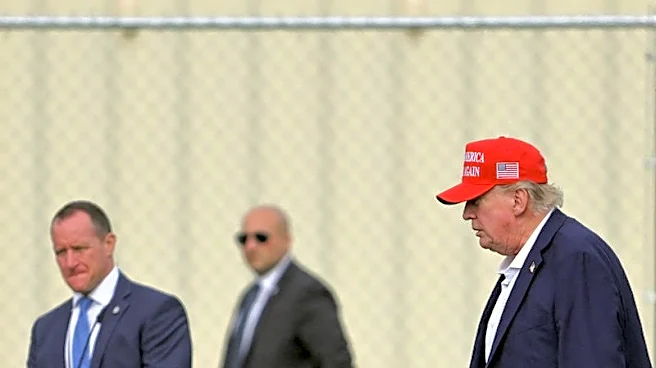
for the war is to 'keep oil and gas cheap' for Americans. He also inaccurately claimed that oil prices were 'way down from the highs in the early days' of the war. In contrast, President Trump, at a New York rally, asserted that the main goal is to prevent Iran from obtaining a nuclear weapon, telling the public that paying 'a tiny little bit more' for gasoline is acceptable for this cause. This divergence in messaging has been highlighted by media outlets, noting that average gas prices have increased significantly since the war began, from under $3 to over $4 per gallon.
Why It's Important?
The conflicting statements from President Trump and Vice President Vance on the Iran war's primary goal create confusion and undermine the administration's unified message on a critical foreign policy issue. This lack of clarity can have significant implications for public perception, international relations, and the morale of U.S. forces. For the American public, inconsistent messaging makes it difficult to understand the rationale behind the ongoing conflict and its associated costs, including rising gas prices. Internationally, it could signal disarray within the U.S. leadership, potentially emboldening adversaries or complicating diplomatic efforts. The discrepancy also highlights a broader pattern of President Trump contradicting his Vice President, which could impact the perceived stability and effectiveness of the White House's decision-making process, especially concerning national security and economic stability.
What's Next?
The conflicting narratives from President Trump and Vice President Vance will likely prompt further scrutiny and calls for clarification from media, political opponents, and the public. The White House may face pressure to issue a definitive statement on the war's objectives to restore coherence to its foreign policy messaging. This situation could also intensify internal discussions within the administration regarding communication strategies and policy alignment. Depending on the political fallout, it might influence public opinion on the war and the administration's handling of foreign affairs, potentially affecting future electoral prospects. The ongoing debate over the war's purpose, whether it's energy price stability or nuclear non-proliferation, will continue to shape policy decisions and public discourse surrounding U.S. engagement in the Middle East.
Beyond the Headlines
The public contradiction between President Trump and Vice President Vance on the Iran war's objectives reveals deeper tensions within the administration and potentially within the Republican party regarding foreign policy priorities. Vance's emphasis on 'cheap oil and gas' reflects a populist concern for domestic economic impact, while President Trump's focus on preventing a nuclear weapon aligns with traditional national security concerns. This divergence could signify a struggle over the ideological direction of U.S. foreign policy, balancing immediate economic interests against long-term geopolitical stability. The incident also underscores the unique dynamics of President Trump's leadership style, where direct contradictions of his subordinates are not uncommon, challenging conventional expectations of a unified executive branch. This pattern could set a precedent for future administrations, altering how the roles of President and Vice President are perceived and how foreign policy is communicated to the nation and the world.