




What's Happening?
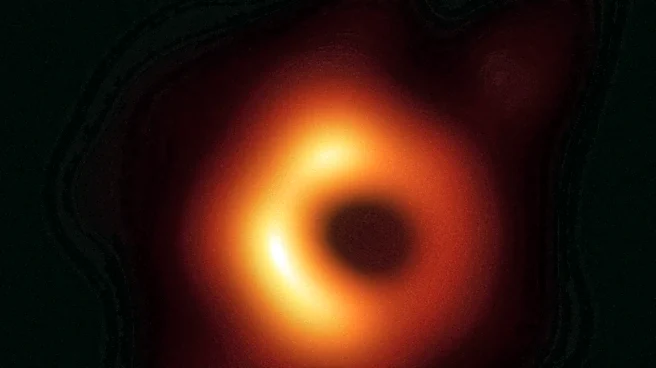
Astrophysicists have effectively eliminated Stupendously Large Black holes (SLABs) from the list of potential dark matter candidates. Dark matter, an invisible substance that does not interact with light, has been a long-standing mystery in physics. While
various hypothetical particles like axions and Weakly Interacting Massive Particles (WIMPs) have been proposed as constituents of dark matter, primordial black holes, including SLABs, were also considered. However, new research indicates that these massive black holes cannot account for the observed density and distribution of dark matter across the cosmos. This finding significantly narrows the ongoing search for the true nature of dark matter, pushing scientists to refine their existing theories regarding the universe's composition.
Why It's Important?
This development is crucial for the field of astrophysics and cosmology as it refines the understanding of dark matter, which is believed to constitute a significant portion of the universe's mass. By ruling out SLABs, scientists can focus their research efforts and resources on other more viable candidates, potentially accelerating the discovery of dark matter's true identity. The existence and nature of dark matter are fundamental to understanding galaxy formation, the large-scale structure of the universe, and the ultimate fate of the cosmos. Eliminating a prominent candidate helps to streamline theoretical models and experimental searches, impacting how future astronomical observations and particle physics experiments are designed and interpreted. This also reinforces the scientific method of hypothesis testing and elimination in the pursuit of fundamental truths about the universe.
What's Next?
The elimination of SLABs as dark matter candidates will likely lead to increased focus on other theoretical models and experimental searches. Researchers will continue to investigate hypothetical particles such as axions and WIMPs, which remain leading candidates. Future experiments, including those at particle accelerators and dedicated dark matter detectors, will be designed to probe the properties of these remaining candidates with greater precision. Additionally, astronomical observations will continue to seek indirect evidence of dark matter's interactions and distribution. The scientific community will also likely explore new theoretical frameworks that can better explain the observed gravitational effects attributed to dark matter, given the constraints provided by this latest research.
Beyond the Headlines
The ongoing quest to identify dark matter has profound implications beyond astrophysics, touching upon fundamental questions about the universe's composition and the limits of current physical laws. The inability to directly observe dark matter challenges the Standard Model of particle physics, suggesting that there are unknown particles and forces at play. This pursuit could lead to a paradigm shift in physics, similar to the discovery of quantum mechanics or relativity. The ethical implications revolve around the allocation of vast scientific resources to a problem that, while fundamental, does not have immediate practical applications. However, the pursuit of such knowledge often yields unexpected technological advancements and a deeper philosophical understanding of our place in the cosmos.