




What's Happening?
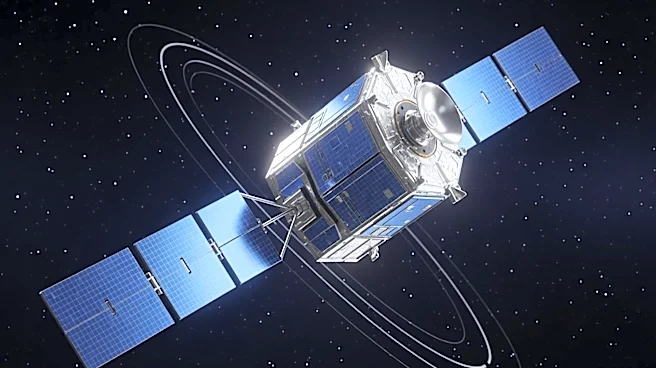
NASA has turned off the Low-Energy Charged Particle (LECP) experiment on the Voyager 1 spacecraft to conserve power. This decision comes as the spacecraft, launched in 1977, faces a critical shortage of nuclear power. Voyager 1, which became the first
spacecraft to enter interstellar space in 2012, is now running low on energy due to a power drop following a roll maneuver in February. The spacecraft, along with its twin Voyager 2, relies on a radioisotope thermoelectric generator that loses about 4 watts of power annually. Currently, only two of Voyager 1's ten science instruments remain operational.
Why It's Important?
The shutdown of the LECP experiment highlights the challenges of maintaining long-term space missions. Voyager 1's diminishing power supply threatens its ability to continue transmitting valuable scientific data from interstellar space. The spacecraft's instruments have been crucial in studying the heliopause and the conditions beyond the solar system. The decision to conserve power by shutting down instruments underscores the need for innovative solutions to extend the mission's lifespan. The potential 'Big Bang' maneuver, aimed at swapping powered devices to conserve energy, could provide a temporary extension of the spacecraft's operational life.
What's Next?
NASA plans to conduct a 'Big Bang' maneuver to extend the power reserves of both Voyager 1 and Voyager 2. This involves turning off certain devices and replacing them with lower-power alternatives to keep the spacecraft warm enough to continue gathering data. Tests on Voyager 2 are scheduled for May and June, with the riskier maneuver for Voyager 1 planned for no earlier than July. If successful, this could allow the LECP experiment to be reactivated, providing additional scientific insights from interstellar space.