







What's Happening?
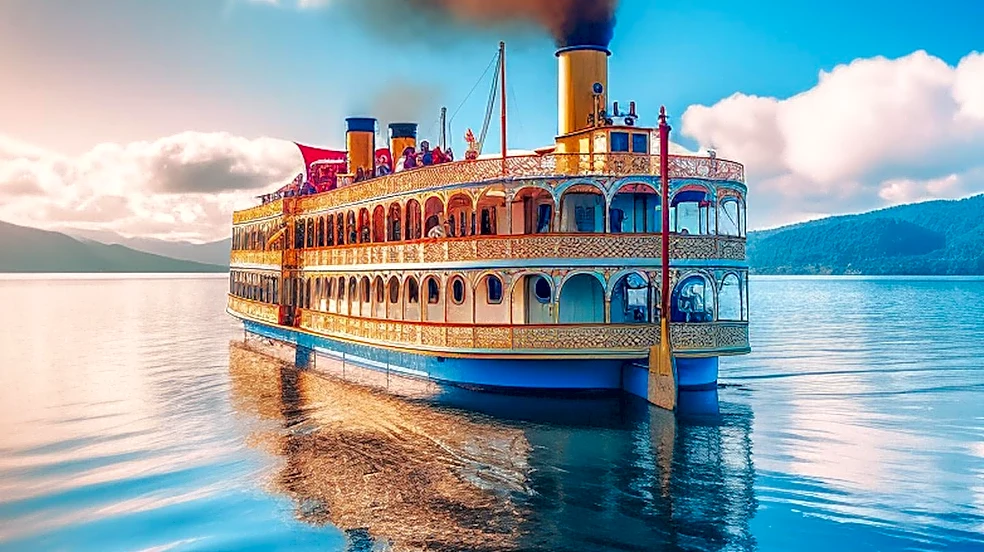
During the Industrial Age, steamships fundamentally transformed water transportation by freeing vessels from reliance on wind. This innovation allowed ocean-going ships to maintain schedules without waiting for favorable winds and enabled river steamboats
to travel upstream at speeds up to five miles per hour, a significant improvement over being towed. The SS Savannah marked a pivotal moment in 1819 by becoming the first steam-powered ship to cross the Atlantic Ocean. Over time, steamships largely replaced traditional sailing ships for worldwide travel. The increased demand for coal to fuel these vessels led to the establishment of coaling stations at strategic points along global trade routes, such as Cape Colony in South Africa and various Pacific islands. These coaling stations became crucial refueling points, highlighting the logistical infrastructure required to support the new era of steam-powered maritime commerce.
Why It's Important?
The advent of steamships had profound implications for global trade, economic production, and geopolitical strategies. By enabling faster and more reliable transportation of goods and people, steamships significantly reduced travel times and increased the efficiency of supply chains. This reliability fostered greater international trade and facilitated the movement of raw materials to industrial centers and manufactured goods to markets worldwide. The need for coaling stations along trade routes also introduced a new dimension to international relations, as control over these strategic points became a motive for imperialism. Nations sought to secure access to these refueling hubs to maintain their maritime dominance and ensure the smooth operation of their trade networks, thereby influencing colonial expansion and territorial disputes. This technological leap was a key factor in shaping the economic and political landscape of the Industrial Age.
What's Next?
The continued evolution of maritime technology, building on the foundation laid by steamships, would see further advancements in propulsion systems and vessel design. The strategic importance of global trade routes and the infrastructure supporting them, such as refueling stations, would remain a critical aspect of international commerce and geopolitical power dynamics. Future developments would likely focus on increasing efficiency, reducing environmental impact, and adapting to new energy sources, moving beyond coal to oil and eventually other forms of propulsion. The legacy of steamships would continue to influence naval architecture and the organization of global shipping, with ongoing efforts to optimize speed, capacity, and operational costs to meet the demands of an ever-expanding global economy.
Beyond the Headlines
The transition from sail to steam represented more than just a technological upgrade; it symbolized a broader shift in human interaction with the natural world and the acceleration of globalization. Steamships embodied the industrial era's drive for control over natural forces, allowing humanity to dictate travel schedules rather than being dictated by wind patterns. This newfound independence from nature fostered a sense of mastery and contributed to the rapid expansion of global networks, intertwining economies and cultures more closely than ever before. The establishment of coaling stations also underscored the environmental impact of industrialization, as the demand for fossil fuels began to shape landscapes and resource extraction efforts globally. This era laid the groundwork for modern global logistics and the complex interdependencies that characterize today's interconnected world.